Choosing a reliable Power Supply manufacturer takes more than comparing prices or reading a headline ranking. Global buyers must examine the details behind each product: output stability, protection features, thermal performance, certifications, and traceable quality controls. A unit may look impressive on a specification sheet. Its behavior under heat, load changes, and long operating hours matters more.
Power-electronics expert Robert W. Erickson, co-author of Fundamentals of Power Electronics, has emphasized through his published work that efficiency must be considered alongside converter control and performance. That is a useful lens for evaluating China’s leading manufacturers. A strong supplier should explain test methods, share relevant technical documents, and respond clearly when requirements change. Ask about sample testing, production consistency, lead times, and after-sales support. Look for evidence, not polished promises.
Small details count. A clean enclosure, labeled terminals, and readable test reports can signal disciplined engineering, though none proves long-term reliability alone. This guide introduces ten Chinese power supply manufacturers for global buyers, with attention to product focus, capabilities, and practical selection factors. It is not a universal verdict. Rankings can simplify a complex market, and the best-fit supplier may not be the largest or cheapest. Buyers should verify claims against their own application, operating environment, and qualification process. A little skepticism helps.
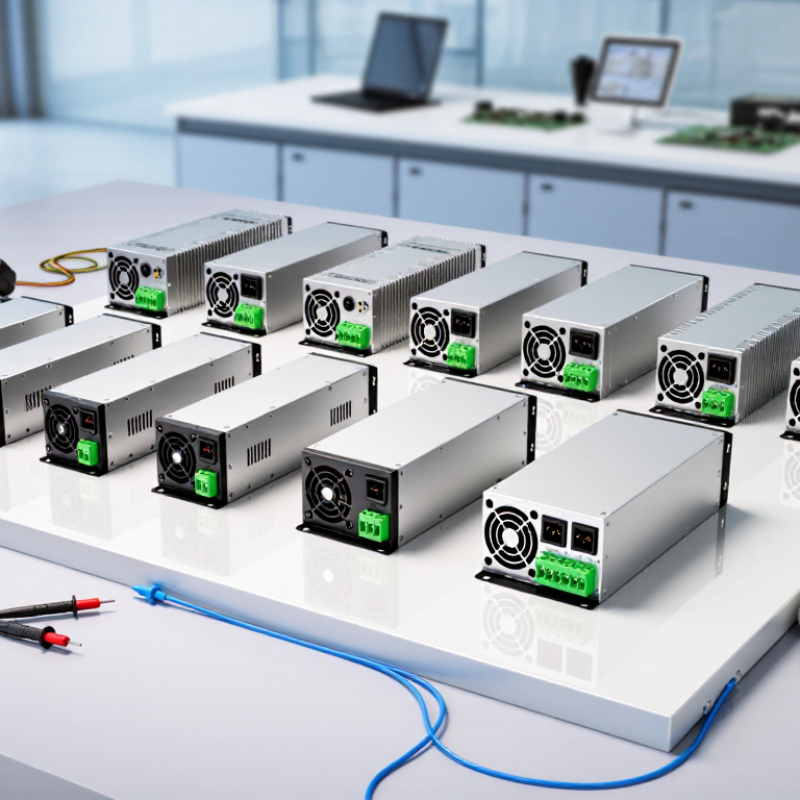
Power Supply Manufacturing in China: Products and Industry Scope
China’s power supply manufacturing covers a wide range of products, from compact AC-DC adapters to enclosed industrial units. Factories may also produce open-frame supplies, DIN-rail models, LED drivers, and battery chargers. The range is broad. These products serve automation, lighting, communications, medical equipment, and consumer electronics, with different requirements for output voltage, power, size, and cooling.
Manufacturing typically combines circuit design, component sourcing, assembly, and electrical testing. For example, a supplier may check output stability under changing loads and inspect a unit’s temperature during operation. Buyers can ask which tests apply to the specific product, rather than relying on a general claim of quality. Details matter. A supply intended for a control cabinet may need a different enclosure and connection layout from one built into a small device.
The industry includes both standard catalog products and made-to-order designs. Custom work can involve connector changes, enclosure dimensions, or output adjustments, but each change may affect lead time and validation. The market is not perfectly uniform; similar labels can refer to different test conditions or component choices. That deserves scrutiny. Comparing technical documents, sample performance, and production consistency gives buyers a clearer view than price alone.
How the Top 10 Manufacturers Were Selected
Choosing ten power supply manufacturers for global buyers requires more than comparing catalog prices. The selection should weigh documented electrical performance, product range, production consistency, and quality controls. Independent test reports matter. So do datasheets listing input range, output tolerance, ripple, and operating temperature. These details help buyers compare products under real conditions, not just ideal lab claims.
A credible shortlist also considers production capacity, lead times, customization, warranty terms, and technical support across time zones. Safety and efficiency certifications should be checked against the exact model and destination market; a company-wide claim may not cover every product. Factory audit records and sample test results can add useful evidence. Yet records may be incomplete, and one sample cannot prove long-term reliability. That limitation deserves attention.
Tips: Request test data for the precise model you plan to purchase, then verify it with a small pilot order. Compare quoted lead times with recent delivery references. Use a scorecard for performance, traceability, service response, and total cost. A polished brochure is not enough. Selection involves judgment. A ranked list can guide research, but buyers still need to validate fit with their load, enclosure, and operating environment.
China’s Top 10 Power Supply Manufacturers at a Glance
China’s top ten power supply manufacturers at a glance represent different strengths, not one interchangeable category. Some focus on compact AC-DC units for control cabinets, while others offer DC-DC converters, open-frame designs, or higher-power systems. Buyers should compare output voltage, rated current, efficiency, operating temperature, and protection features against the actual application. A 24-volt, 10-amp unit may suit one cabinet, yet its heat output could be a problem in a sealed enclosure.
Manufacturing capability matters as much as a product sheet. Look for clear information about quality checks, production capacity, customization, and sample availability. Ask for current test documents and confirm that the stated specifications match the model being quoted. Small details matter. Connector placement, terminal spacing, and cooling requirements can affect installation time and maintenance access. Response speed also counts, especially when engineers need answers about a nonstandard load or enclosure.
A short list of ten suppliers is a starting point, not proof that each one fits a project. Compare samples under realistic loads, check delivery estimates, and clarify warranty terms before placing a large order. Not always easy. Public product information may leave gaps, and buyers should verify key claims directly rather than assume every model offers the same protections or service. The best comparison is practical: stable output, predictable lead times, usable documentation, and support that remains available after delivery.
China’s Top 10 Power Supply Manufacturers at a Glance
A buyer-focused benchmark: minimum 80 PLUS efficiency thresholds for common power-supply certification levels. These are certification criteria, not ratings of individual manufacturers.
Efficiency thresholds shown are for 115 V internal, non-redundant power supplies. Actual performance varies by model and operating conditions.
How Their Products, Certifications, and Capabilities Compare
Comparing ten power supply manufacturers means looking beyond headline wattage. Check whether each range covers compact AC/DC modules, enclosed supplies, DIN-rail units, or high-power systems. A label may show 24 volts and 10 amps, but thermal performance can change inside a sealed cabinet. Ask for derating curves, efficiency data, ripple figures, and operating-temperature limits. These details help buyers match a unit to the actual load, not just the catalog description.
Certifications matter, but their scope matters more. Confirm that the exact model and intended market appear in current test documents; a certificate for one product family may not cover every variant. Compare safety approvals, electromagnetic compatibility evidence, and quality-system records, then verify them with the issuing body where practical. Manufacturing capability also deserves close review: production capacity, customization controls, traceability, and response times for engineering questions can affect delivery and long-term support. Request a sample and inspect its terminals, labeling, and documentation. Small clues count. A neat datasheet is useful, yet it cannot prove consistent output under heat, vibration, or fluctuating loads. I would compare test evidence carefully—and admit that supplier claims can still leave gaps.
What Global Buyers Should Verify Before Sourcing
Before choosing among China’s top 10 power supply manufacturers, verify the exact model—not just the factory’s general certificates.
Request safety test reports, efficiency curves, and written confirmation that the tested unit matches the quoted configuration. Check performance at low, typical, and full load; a single peak-efficiency figure can hide weak results in real use. Inspect ripple, protection behavior, thermal derating, and operation after prolonged heat exposure.
Paperwork is not proof.
Efficiency deserves close attention. Lawrence Berkeley National Laboratory’s 2024 United States Data Center Energy Usage Report estimates that data centers used
4.4% of U.S. electricity in 2023, with their share potentially reaching
6.7%–12% by 2028. That forecast concerns whole data centers, not power supplies alone, but it shows why conversion losses matter. Ask for measurements from an independent lab and confirm the test conditions. Also review component traceability, factory change-control records, warranty terms, and sample-to-production consistency. A factory audit can reveal practical gaps, though one visit cannot guarantee every shipment. Keep the questions specific, and record any unanswered point before placing an order.
Conclusion
China’s power supply manufacturing sector covers a broad range of products for industrial, commercial, and consumer applications. This overview explains the industry’s scope and outlines a consistent approach to identifying ten manufacturers for global buyers, considering factors such as product range, production capabilities, quality management, and export experience. It also offers a concise comparison framework to help readers understand how suppliers may differ in the solutions they provide.
Before sourcing, buyers should verify that a product’s specifications match the intended application and that relevant certifications and test documentation are current and appropriate for the target market. It is also important to assess manufacturing capacity, quality-control processes, customization options, lead times, communication, and after-sales support. These checks can help buyers evaluate suppliers more clearly, manage sourcing expectations, and choose a Power Supply partner suited to their technical and commercial requirements.
 Deutsch
 Español
 Français
 Português
 Italiano
 Русский
 العربية
 Türkçe
