Technical Sourcing FAQ
Frequently Asked Questions on CE Certified Regulated Power Supplies
Practical answers addressing regulatory compliance, thermal derating, customized topologies, and commercial terms.
What specific standards define a "CE Certified" regulated power supply in industrial applications?
A genuine CE mark on an AC/DC regulated power supply demonstrates compliance with two primary European Directives: the Low Voltage Directive (LVD 2014/35/EU), typically satisfied via EN 62368-1 (audio/video, information and communication technology equipment safety), and the Electromagnetic Compatibility Directive (EMC 2014/30/EU), satisfied via EN 55032 for conducted and radiated emissions and EN 55035 / EN 61000-6-2 for immunity. Harlon provides complete test reports covering dielectric withstand voltage (Hi-pot), clearance/creepage distances, and harmonic current limits under EN 61000-3-2.
How do high ambient operating temperatures affect the output rating of SMPS units?
All switch-mode power supplies experience thermal derating as ambient temperatures rise above standard test baselines (typically 40°C or 50°C). Under elevated temperatures, the internal magnetic components and switching semiconductors generate heat faster than convection or forced air can dissipate it. For example, a 200W unit might provide 100% rated output up to 50°C, but must be derated by 2.5% per °C between 50°C and 70°C, providing 100W at maximum operating limits. Our engineering datasheets detail exact derating curves so engineers can size power supplies accurately for high-temperature environments.
Can Harlon customize voltage outputs, housing dimensions, or terminal blocks for OEM projects?
Yes. Zhejiang Harlon Electronic provides comprehensive OEM and ODM capabilities backed by 18 years of export manufacturing. We offer sample-based customization, schematic modifications, and custom housing designs. Typical OEM adjustments include non-standard DC rails (e.g., 18V, 36V, 60V), customized metal casing footprints for space-restricted machinery, specialized pluggable terminal blocks, IP67 conformal potting, and buyer branding/packaging.
What is the difference between linear regulated power supplies and switching (SMPS) power supplies?
Linear regulated power supplies drop surplus voltage across a dissipative pass element (such as a transistor), which yields low output ripple and noise but results in poor efficiency (often 30%–50%) and bulky, heavy transformers. Switching power supplies (SMPS) chop DC voltage at high frequencies using PWM or resonant controllers, achieving efficiency ratings of 85% to 94%+. This dramatically reduces heat generation, shrinks the magnetic core size, and produces compact, lightweight enclosures ideal for modern industrial automation cabinets and LED displays.
What built-in protection mechanisms are standard across Harlon regulated power supplies?
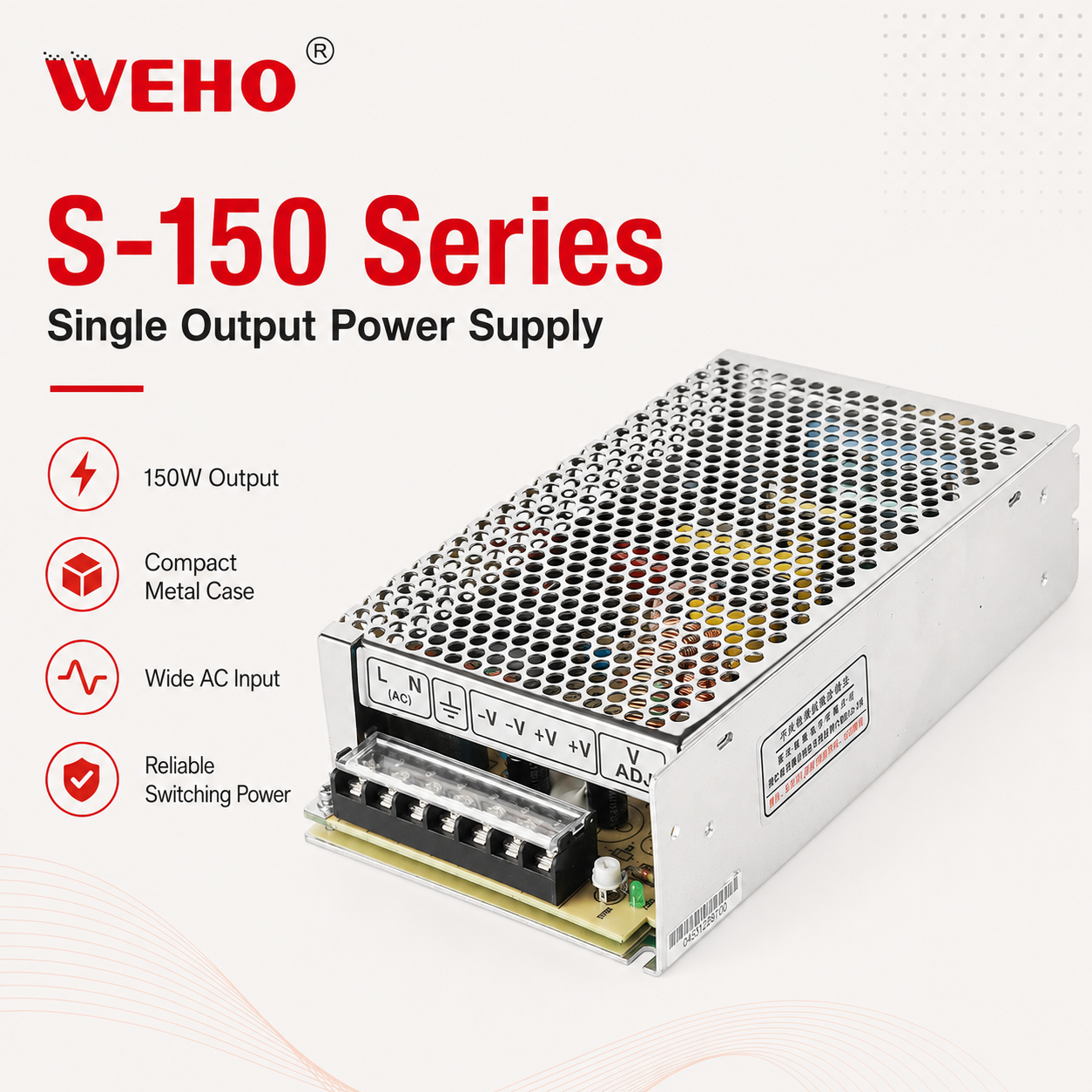
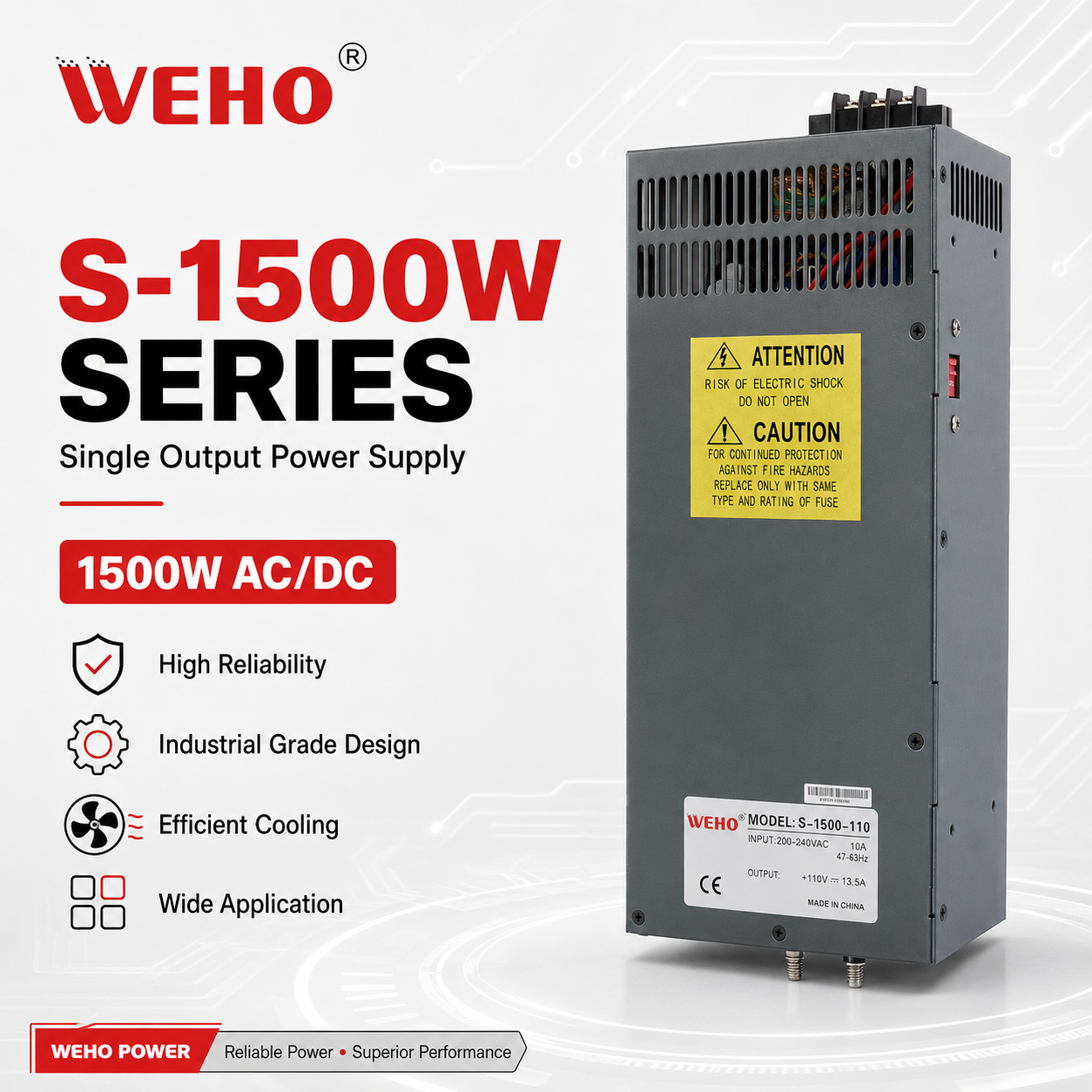
Our regulated power supplies include four levels of internal circuit protection: Overload / Overcurrent Protection (OCP) using hiccup mode or constant current limiting; Overvoltage Protection (OVP) via zener-clamped feedback shutdown; Short-Circuit Protection (SCP) with automatic continuous recovery once the fault is cleared; and Over-Temperature Protection (OTP) on mid-to-high wattage models (such as our 150W+ and fan-cooled 1500W units) that shuts down switching until internal thermistors detect safe junction temperatures.
What trade terms, lead times, and payment methods are supported for volume orders?
We support standard international commercial terms including FOB Ningbo/Shanghai, CIF, CFR, EXW, and DDU/DDP via express or freight carriers. Payment methods accepted include T/T, L/C at sight, PayPal, and Western Union in USD, EUR, or CNY. Typical production lead time for standard catalog models ranges between 7 to 15 business days, while full OEM/ODM customized orders generally take 20 to 30 days depending on component tooling and certification cycles.
 Deutsch
 Español
 Français
 Português
 Italiano
 Русский
 العربية
 Türkçe