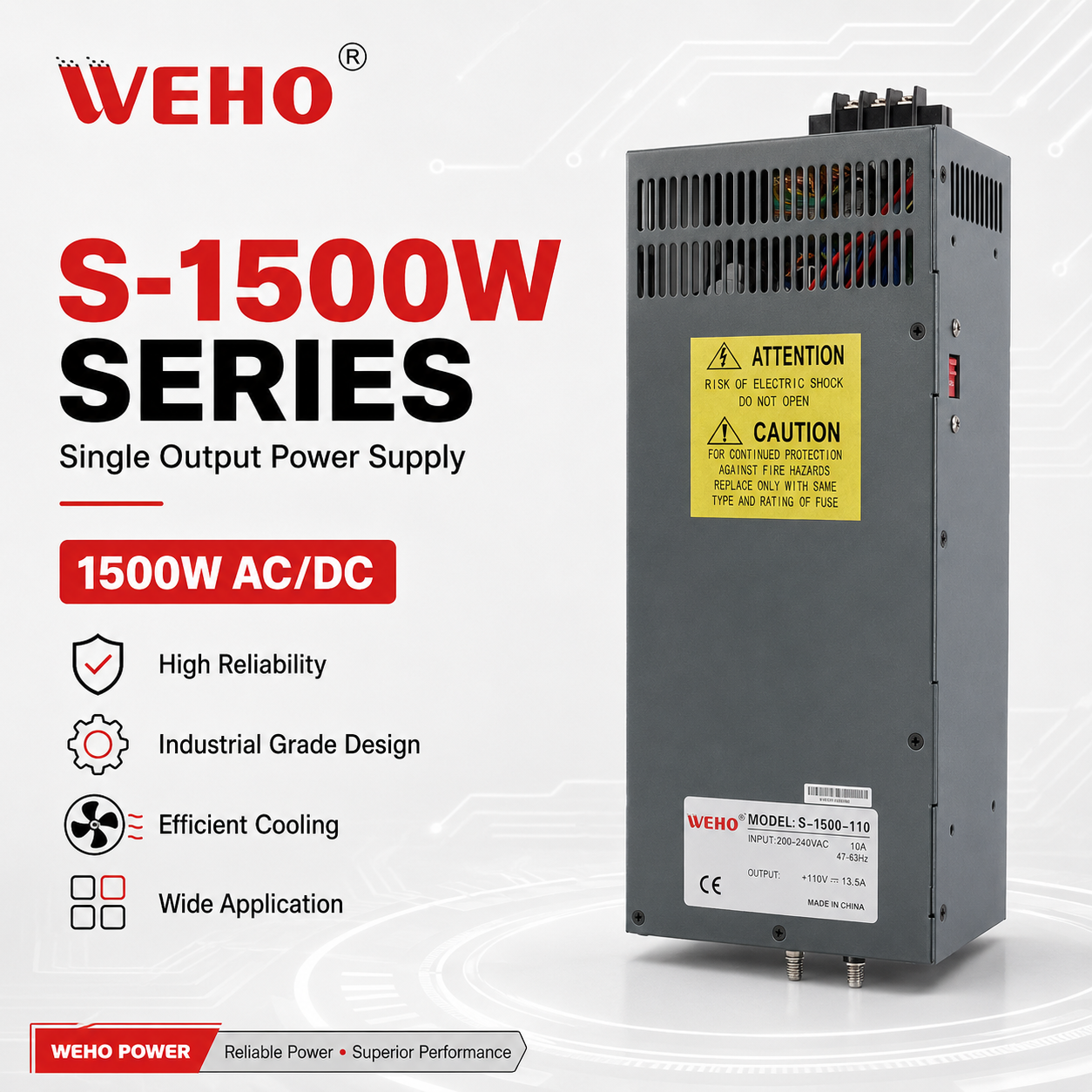
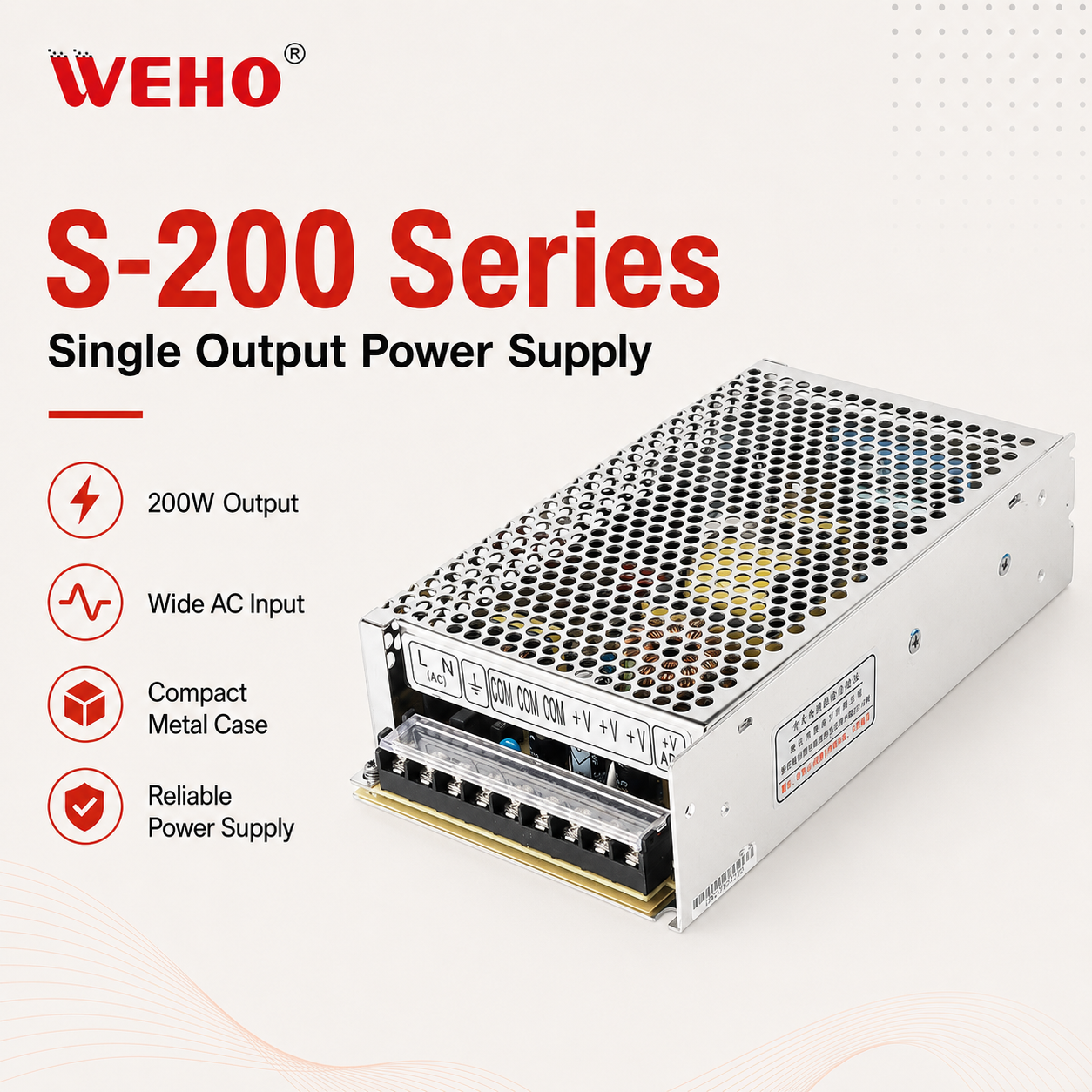
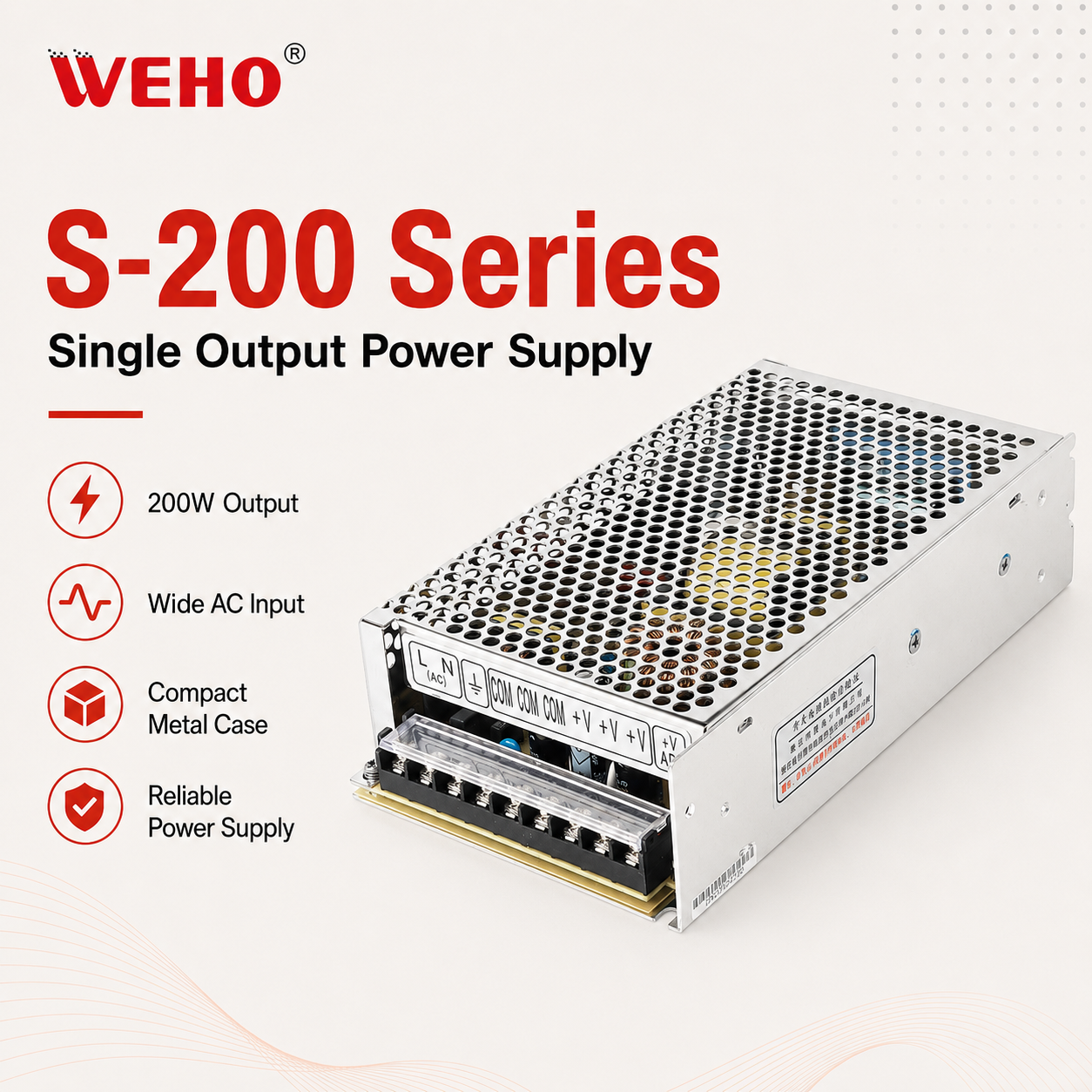
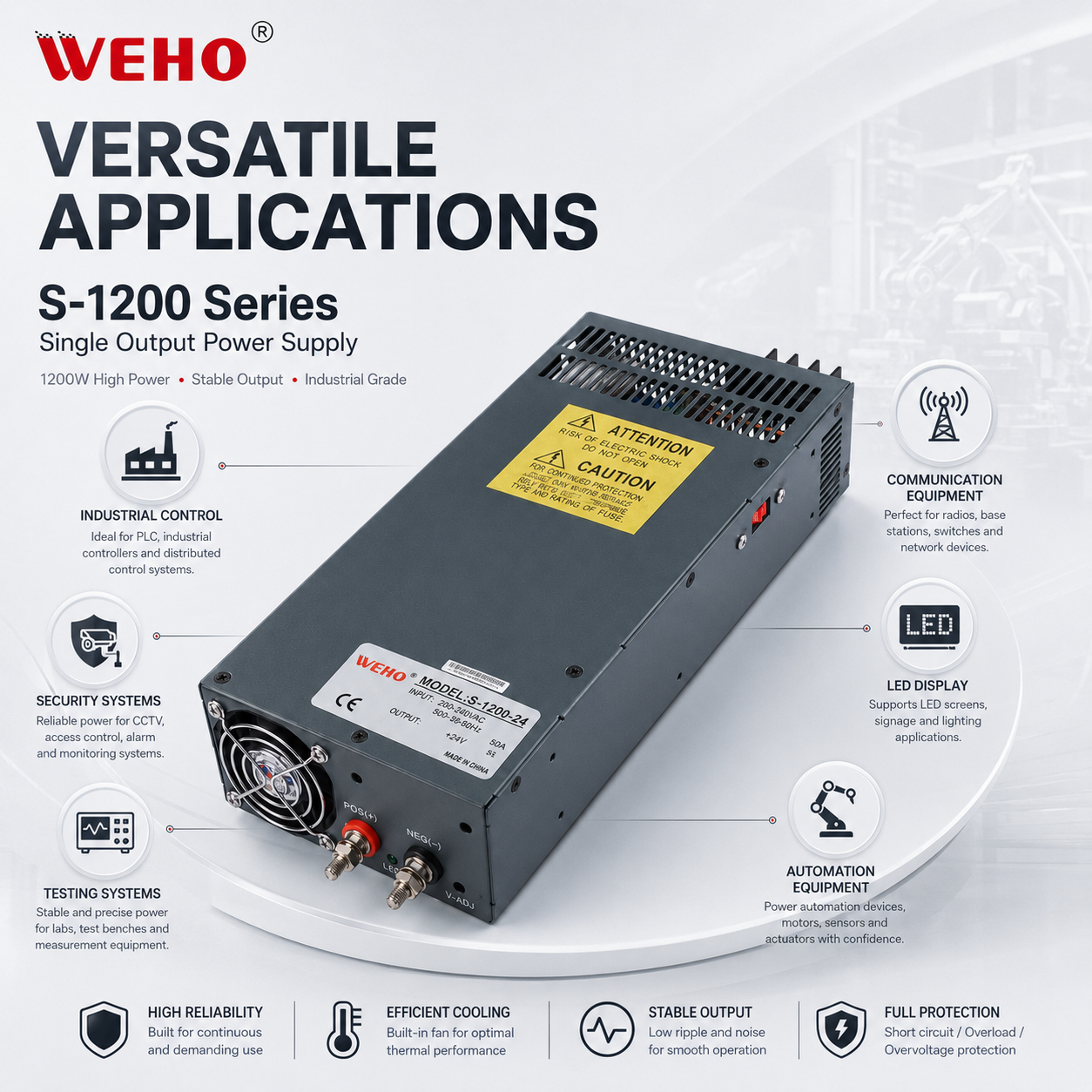
Tested under 100% full-load high-temperature burn-in protocols. Precision-regulated voltage outputs tailored for fine-pitch indoor video walls, high-brightness outdoor DOOH billboards, and stage rental cabinets.
In modern visual engineering, an LED video wall is only as dependable as the switched-mode power conversion modules nestled inside its aluminum magnesium cabinets. Unlike ordinary consumer power adapters, an LED display power supply operates under relentless, highly volatile dynamic loads. Video content transitions—from high-contrast scenes to sudden high-luminance flashes—trigger microsecond current spikes from single-digit amperes to several hundred amperes.
Inferior switching power units introduce critical engineering bottlenecks: high ripple voltage creates electromagnetic interference (EMI) that degrades the video synchronization pulses processed by receiving cards (such as NovaStar, Colorlight, and Brompton), manifesting as visible horizontal scanning lines, dark ghosting shadows, and uneven grayscale reproduction. Furthermore, severe thermal accumulation in compact die-cast cabinets degrades electrolytic capacitor electrolytes, resulting in premature field failure rates.
Procurement teams must calibrate bills of materials against these minimum operational parameters:
How advances in wide-bandgap semiconductors, dynamic thermal dissipation, and common-cathode topologies are shaping future LED display infrastructure.
Traditional displays utilize common anode architecture distributing 5V DC universally to Red, Green, and Blue dies. Because Red LEDs operate optimally near 2.8V, the excess voltage dissipates as waste heat. Next-gen common-cathode power supplies provide decoupled dual-rail outputs (e.g., 2.8V for Red, 3.8V for Green/Blue), slashing thermal generation by up to 35% and extending display longevity.
To support ultra-thin architectural cabinets (under 30mm chassis depth), switching frequencies are elevated from conventional 65kHz to beyond 200kHz using GaN MOSFETs. Paired with LLC half-bridge zero-voltage switching (ZVS) resonant converters, electrical conversion yields surpass 92%, drastically shrinking the magnetic core size of transformers.
For broadcast television, command-and-control operations rooms, and live stadium events, catastrophic blackout is zero-tolerance. Procurement mandates are pivoting heavily toward current-sharing redundant architectures where dual power supplies share load in parallel. If one unit faults, the auxiliary module absorbs 100% capacity without a microsecond of visual glitch.
Outdoor DOOH displays face corrosive maritime salt sprays, monsoon rains, and extreme humidity swings. Advanced manufacturers apply automated dual-side robotically sprayed conformal coatings (military-grade polyurethane or silicone potting) exceeding IP65/IP67 ingress ratings to safeguard SMT traces against electrochemical migration.
Tightening electrical efficiency regulations across the European Union (ErP Ecodesign) and North America (Energy Star) demand active PFC circuits. APFC drastically minimizes total harmonic distortion (THD < 10%), preventing massive neutral wire overheating and transformer humming in colossal venue video displays drawing hundreds of kilowatts.
Next-tier system integration links power supplies into central network control platforms via PMBus or Modbus RS485 interfaces. Engineers can monitor real-time output current, board-level temperatures, operating hours, and early degradation markers directly from remote cloud diagnostic dashboards.
Understanding why using generic industrial open-frame units in LED video cabinets leads to catastrophic field failures.
| Evaluation Parameter | Generic Industrial Power Supply | Dedicated LED Video Wall Power Supply | Procurement Impact |
|---|---|---|---|
| Load Step Response | Slow (10ms – 50ms) | Ultra-Fast (< 200μs dynamic recovery) | Prevents image flicker during high-contrast video cuts. |
| Ripple & Noise | Typically 150mV – 300mVp-p | Suppressed to ≤ 80mV – 120mVp-p | Eliminates video signal line distortion & ghosting. |
| Physical Height Profile | Bulky (50mm – 80mm height) | Ultra-Low Profile (19mm – 30mm height) | Permits ultra-thin die-cast cabinet designs. |
| Cooling Methodology | High-RPM, noisy miniature fans | Fanless pure convection or smart silent fan | Crucial for broadcast studios and conference rooms. |
| Thermal Derating Margin | Rapid de-rating above 40°C | Heavy derating allowance up to 70°C | Guarantees 24/7 reliability in sealed outdoor displays. |
| Inrush Current Limiting | Basic NTC Thermistor | Active Soft-Start Relay + Multi-Stage NTC | Prevents circuit breaker tripping at master AC power-on. |
Zhejiang Harlon Electronic Co., Ltd. delivers direct factory engineering expertise backed by 19 years of independent power electronics manufacturing.
Premises, production capacity, and legal compliance verified by on-site SGS international audit. Full ISO 9001 quality management from raw material acceptance to final packaging.
Equipped with high-precision SMT pick-and-place lines, automatic through-hole insertion, nitrogen-protected wave soldering, and automated double-liquid potting robots.
Every single power unit undergoes continuous high-temperature full-load burn-in screening to eliminate infant mortality defects before export packaging.
Complete test infrastructure including lightning surge generators, EMI conduction receivers, shielding chambers, and high-voltage dielectric test stations.
Expert answers addressing electrical calculations, certification compliance, thermal derating, and factory customization.
To calculate required wattage with long-term engineering reliability, you must identify: (1) The maximum power draw per LED module at peak white brightness (100% R, G, B illumination), and (2) The number of modules powered per cabinet. Multiply the module count by the peak module wattage.
Crucial Derating Formula: Never operate switching power supplies continuously at 100% rated capacity in an enclosed environment. Apply an operational safety margin of at least 20% to 30%. For example, if a cabinet draws 160W peak power at 5V, choose a minimum 200W (5V 40A) power supply. For extreme outdoor environments exceeding 45°C ambient temperature, apply a 35% margin to prevent thermal protection cut-offs.
Ripple voltage is the residual periodic AC variation superimposed on the regulated DC output resulting from high-frequency switching and incomplete capacitor smoothing. In LED displays, excessive ripple (>150mV) modulates the constant-current driver ICs operating the pixel matrix.
This causes chromatic inconsistency across panel edges, noticeable moiré patterning, and horizontal banding artifacts during high-frame-rate camera broadcasts (critical in XR virtual production stages and sports stadiums). High-grade LED display power supplies utilize low-ESR solid electrolytic capacitors paired with multi-stage LC filters to keep ripple below 80mVp-p under full dynamic swing.
It depends strictly on the power supply's primary bridge rectifier and PFC architecture. Units marked specifically as 220V AC Only will suffer severe undervoltage lockout or excessive internal primary current stress if plugged into 110V/115V mains.
For international export versatility, reputable manufacturers engineer two solutions: (1) Manual Slide Switch Selection (115V / 230V AC toggle), or (2) Universal Full-Range Input (85V – 264V AC with Active PFC). If your rental displays travel across North America, Japan, and Europe, always specify universal 85-264VAC input units with active PFC.
For the European Union, power supplies must carry verified CE marking compliant with the Low Voltage Directive (LVD EN 62368-1) and Electromagnetic Compatibility Directive (EMC EN 55032 Class B, EN 55035, EN 61000-3-2 harmonic limits), accompanied by RoHS documentation.
For North America, certification under UL 62368-1 (Audio/Video and Information Tech Equipment) or equivalent ETL / CSA standards is mandatory for commercial architectural installations and municipal building inspection approvals. We provide comprehensive test reports and declaration certificates on all qualified series.
Under industrial operating guidelines, a premium LED display SMPS exhibits an MTBF (Mean Time Between Failures) of 100,000 to 200,000 hours (approximately 5 to 8 years of continuous operation). The definitive limiting factor is the lifespan of primary and secondary electrolytic capacitors.
According to Arrhenius' Law, every 10°C increase in capacitor core temperature halves the chemical lifespan of the electrolyte. This is why our designs employ 105°C-rated capacitors from Japanese and premier Tier-1 suppliers, reinforced by high thermal-conductivity aluminum backplates and aerospace-grade thermally conductive potting silicone.
Yes. Backed by 19 years of power electronics development, our in-house R&D engineering team provides rapid end-to-end OEM and ODM customization. We routinely modify:
Get complete engineering datasheets, full-range schematic diagrams, and competitive direct volume factory pricing. Share your project parameters (input voltage, required DC rails, cabinet dimensions, and annual quantities) for a fast proposal.