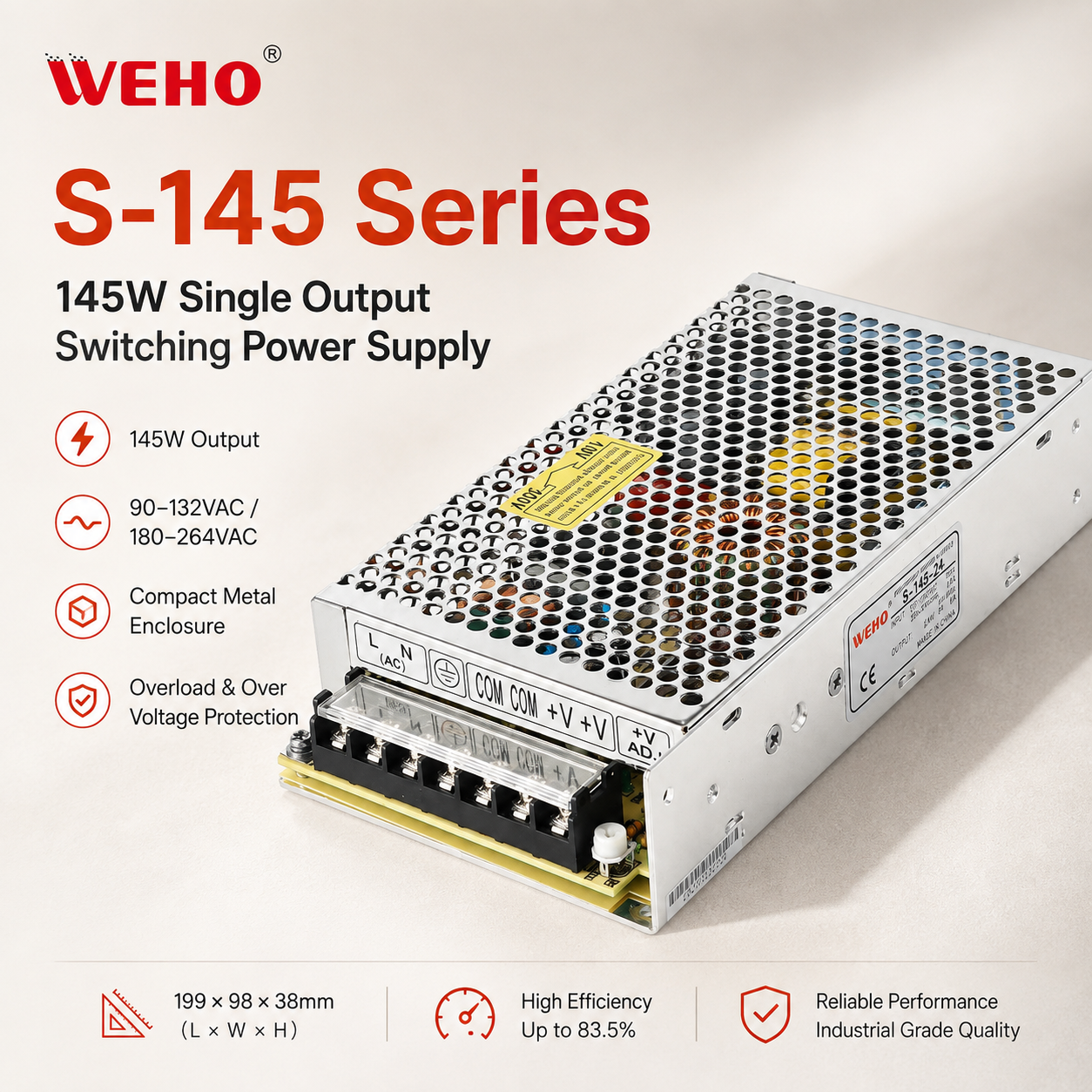
48V Precision Rail
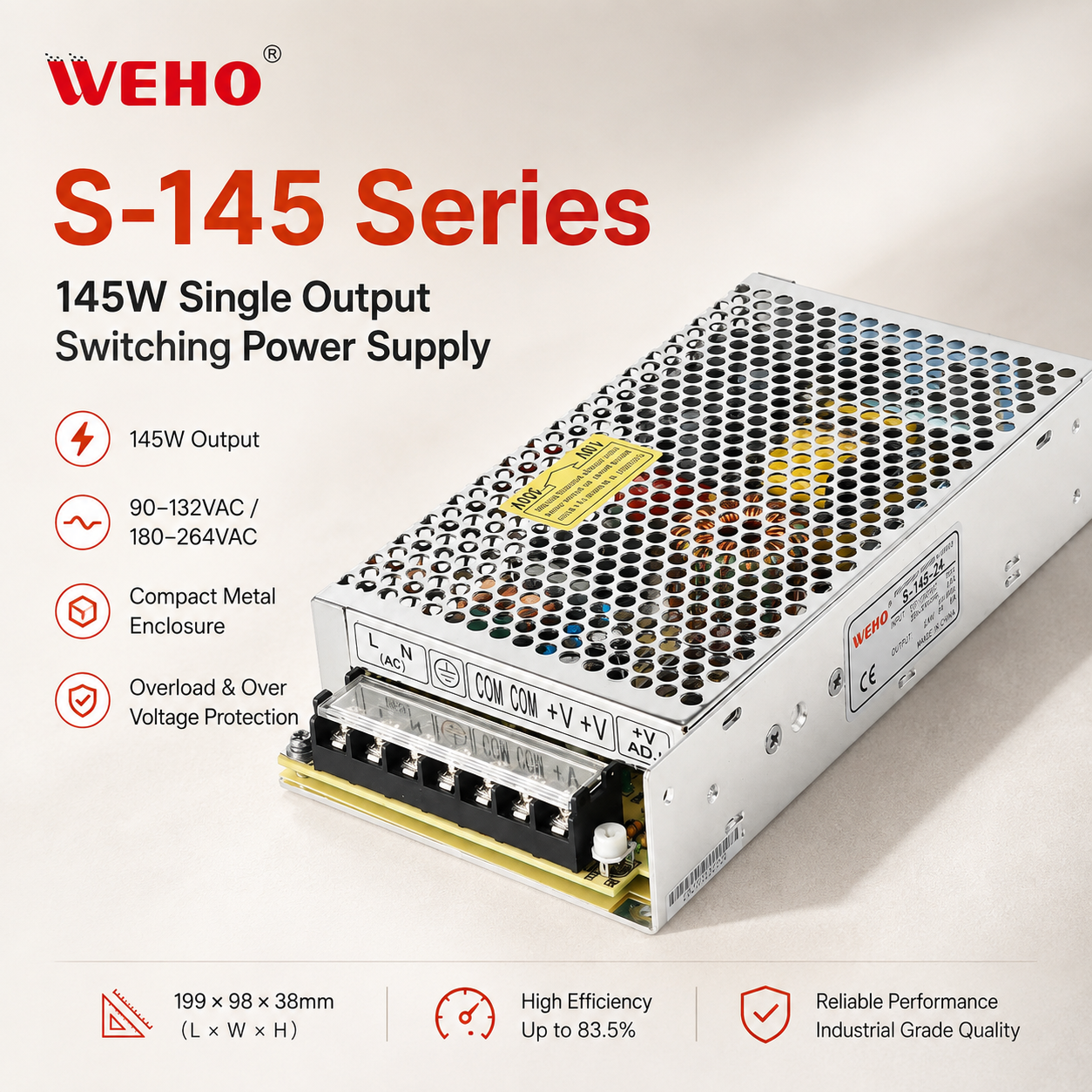
WEHO 145w 48v Single Output Ac/dc Switching Power Supply 3a
Output: 48V DC / 3A
Power: 145W Max
Input: Universal AC
Cooling: Convection
Our export team supports buyers in these languages:
 Deutsch
 Español
 Français
 Português
 Italiano
 Русский
 العربية
 Türkçe
Every switching power supply and LED driver manufactured by Zhejiang Harlon undergoes 100% full-load high-temperature burn-in testing to guarantee zero field mortality for international project deployments.
In high-performance commercial and industrial solid-state lighting (SSL), delivering a constant current is crucial to regulating light output and preserving diode life. Light-emitting diodes are non-linear semiconductor devices characterized by an exponential current-voltage ($I-V$) curve. As forward voltage ($V_f$) fluctuates due to thermal changes and manufacturing tolerances, a tiny voltage shift can cause a catastrophic surge in current. This thermal runaway scenario damages phosphor coatings, degrades luminous flux, and permanently destroys the PN junction.
As a leading China wholesale constant current LED driver manufacturer and exporter, Zhejiang Harlon Electronic Co., Ltd. designs isolated switch-mode power supplies (SMPS) integrating active primary-side or secondary-side feedback loops. These loops continuously monitor the forward current across external sensing resistors and adjust pulse-width modulation (PWM) duty cycles in real time. This guarantees that whether driving a string of high-power COB (Chip-on-Board) modules or hundreds of mid-power SMD diodes in series, output current remains locked within a tight tolerance of ±3% to ±5% across universal AC line swings (90V to 305V AC).
Depending on target power ratings, efficiency thresholds, and physical form factors, our power supplies utilize distinct conversion topologies:
1. Single-Stage Isolated Flyback (15W to 75W): For low-to-medium wattage indoor luminaires, cost efficiency and compact form factors are paramount. Our single-stage flyback drivers utilize quasi-resonant (QR) switching with integrated active Power Factor Correction (PFC). This architecture combines energy transfer and primary-side current sensing within a single magnetic core, eliminating optocouplers to extend driver lifespan in elevated operating ambients ($T_a = 50^\circ\text{C}$).
2. Two-Stage Boost PFC + Forward / LLC Half-Bridge (80W to 350W): For architectural fixtures, linear high-bays, and stadium floodlights, single-stage ripple current (typically 30% to 40% at 100Hz/120Hz) is unacceptable. Our high-grade wholesale drivers implement a dedicated front-end Boost PFC stage to raise the bus voltage to a steady 400V DC while keeping Total Harmonic Distortion (THD) under 10% and Power Factor (PF) above 0.98. The second stage uses an LLC resonant converter operating under Zero Voltage Switching (ZVS), pushing conversion efficiency up to 93.5% and suppressing low-frequency current ripple below 3%, achieving full compliance with the IEEE 1789-2015 "no effect" flicker standard.
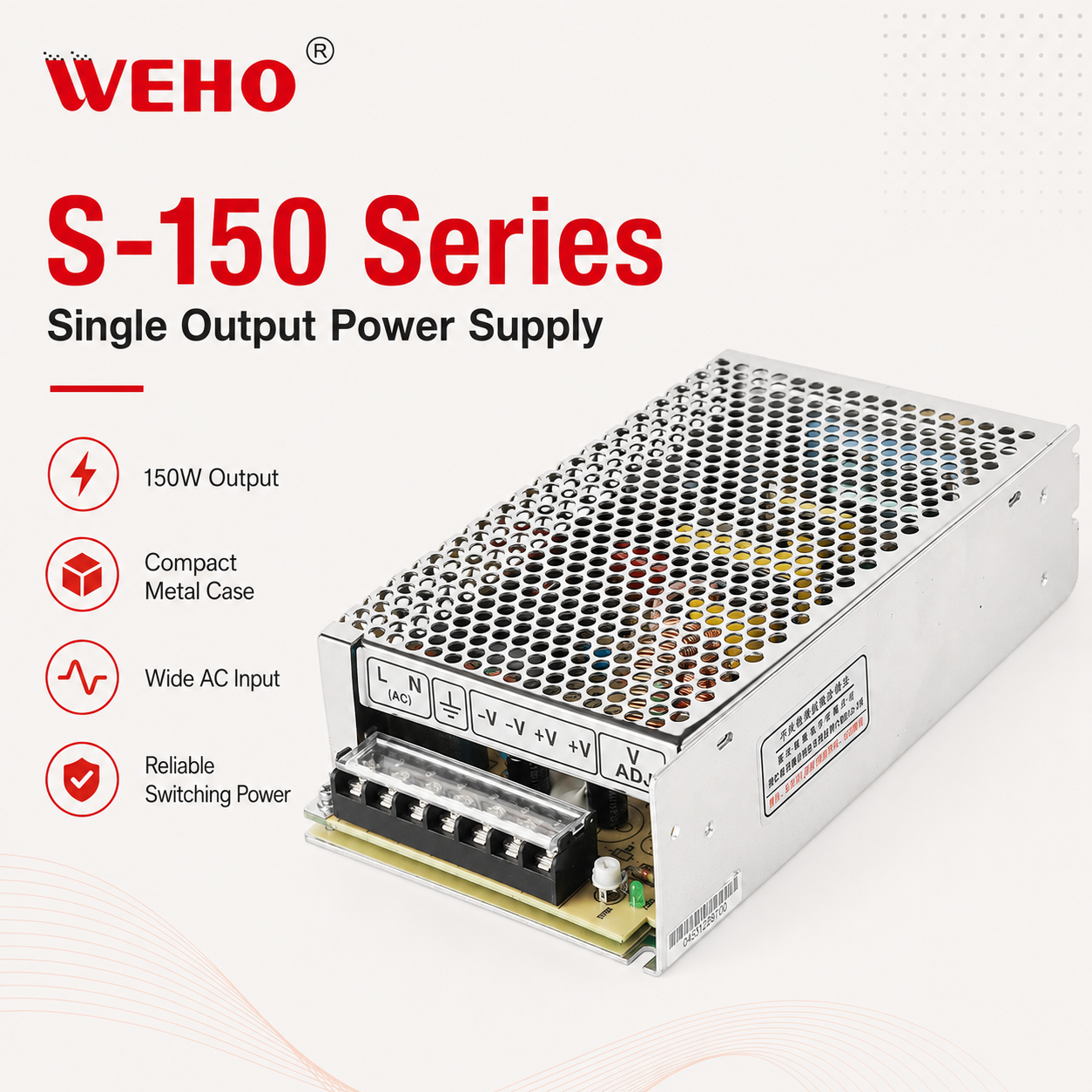
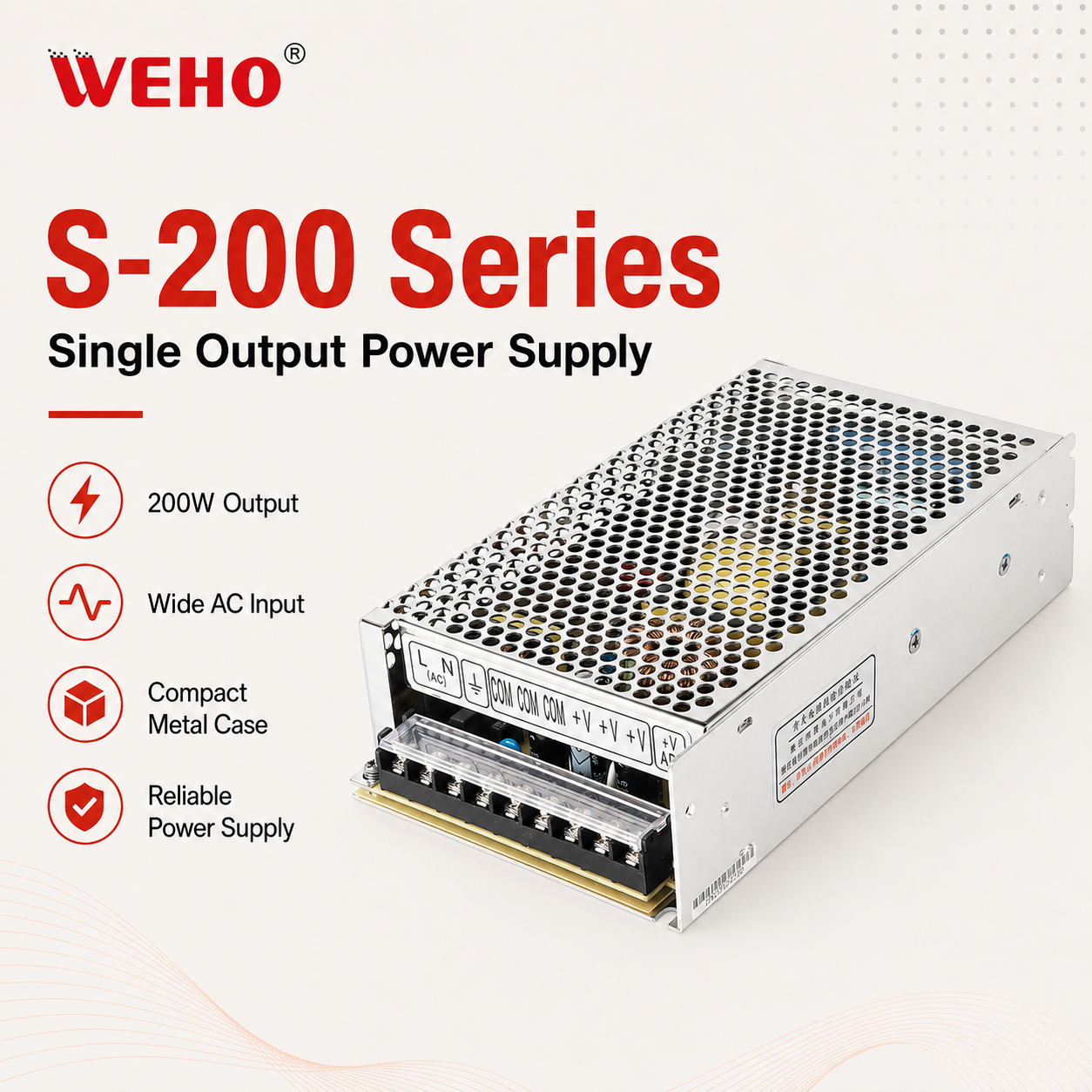
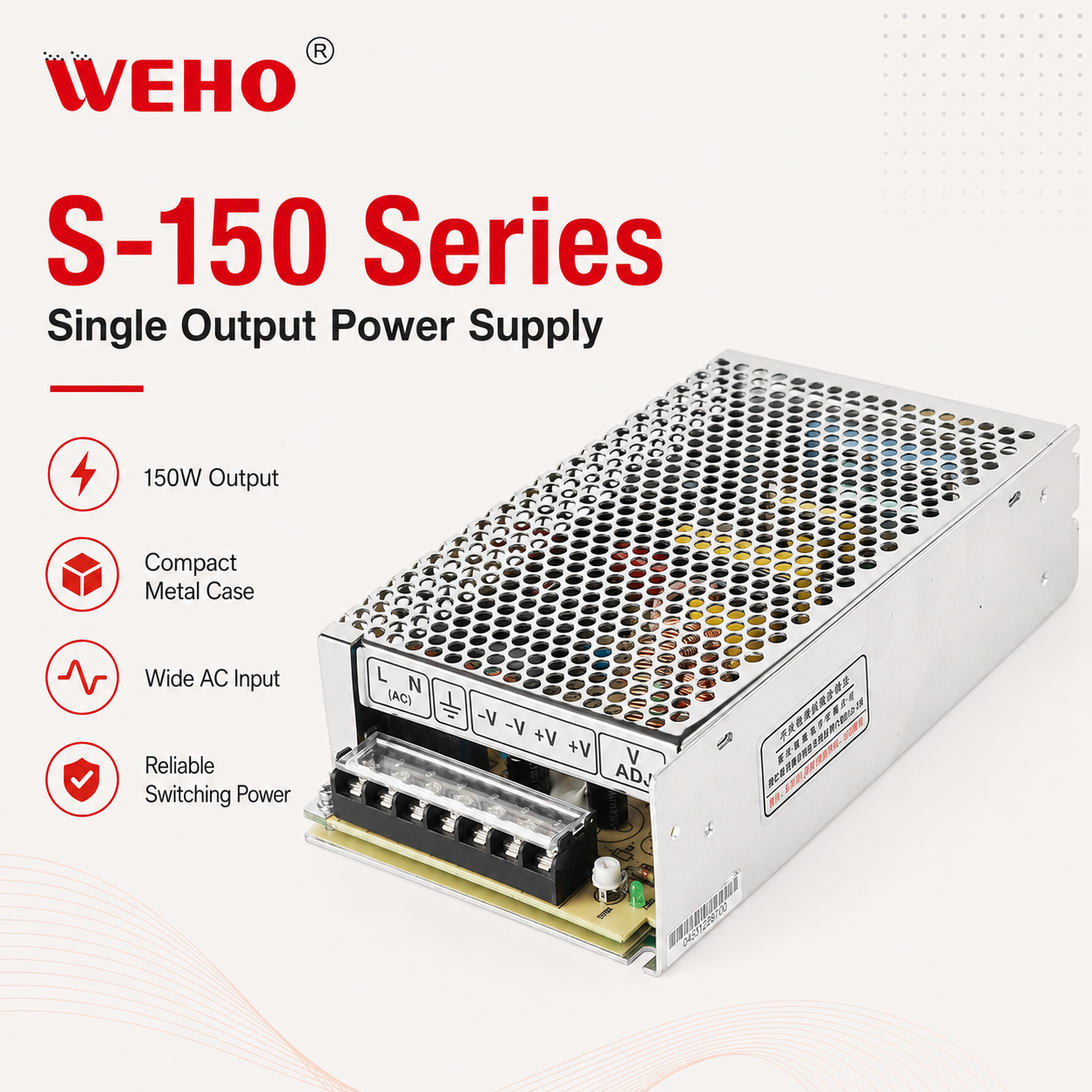
3. Synchronous Buck Post-Regulator Arrays (Multi-Channel DC-DC): For dynamic architectural installations and multi-channel tunable white (CCT) systems, our multi-rail platforms take a robust 48V DC bus (such as that supplied by the WEHO-145W-48V or S-150-48 units) and step down to multiple constant current rails via discrete buck converters. This enables independent deep dimming down to 0.1% without chromaticity shift or audible coil whine.
| Electrical Parameter | Commercial Grade (Indoor) | Industrial Grade (High-Bay / Warehouse) | Municipal / Outdoor (Street / Façade) |
|---|---|---|---|
| Input Voltage Operating Range | 100–240V AC (±10%), 50/60Hz | 90–305V AC / 127–431V DC | 100–277V AC (Optional 347–480V AC HV) |
| Power Factor (PF) & THD | PF > 0.90 @ Full Load, THD < 15% | PF > 0.95 @ 230V AC, THD < 10% | PF > 0.98 @ Full Load, THD < 8% |
| Output Current Ripple (Flicker) | < 5% (Low Ripple) | < 3% (Flicker-Free IEEE 1789) | < 2% (Camera Recording & Sports Compliant) |
| Surge Immunity (L-N / L-PE) | 1kV Differential / 2kV Common | 4kV Differential / 6kV Common | 6kV Differential / 10kV Common Mode (MOV + GDT) |
| Inrush Current Suppression | NTC Thermistor Bypass | Active Relay + NTC Thermal Bypass | Active Soft-Start Circuit (< 20A peak) |
| Efficiency Range | 86% – 89% | 90% – 93.5% | 92% – 95% (GaN Stage Available) |
| Mean Time Between Failures (MTBF) | > 250,000 Hours (MIL-HDBK-217F) | > 400,000 Hours @ 50°C Ambient | > 500,000 Hours @ Tc 75°C Case Temp |
Navigating global supply chain shifts, tightening international energy mandates, and the shift toward software-defined, connected solid-state lighting architectures.
Commercial buyers are demanding higher power density ($W/\text{in}^3$) to fit ultra-compact luminaire extrusions. Transitioning from silicon MOSFETs to Gallium Nitride (GaN) high-electron-mobility transistors (HEMTs) slashes switching losses by up to 60%, allowing switching frequencies to exceed 200kHz. This shrinks planar transformers and passive filter components while keeping thermal dissipation inside sealed IP67 enclosures to a minimum.
Drivers are no longer simple power converters; they serve as digital data nodes in intelligent building automation. Modern procurement tenders specify DALI-2 Part 251 (luminaire asset management), Part 252 (energy metering reporting with ±1% accuracy), and Part 253 (diagnostic diagnostics and driver operating hours). Integrated auxiliary 24V DC bus outputs eliminate secondary supplies, directly powering wireless mesh nodes and microwave sensors.
With Europe enforcing Commission Regulation (EU) 2019/2020 (Single Lighting Regulation) and mandatory right-to-repair standards, international buyers increasingly reject permanently potted, non-repairable assemblies for indoor installations. Procurement trends favor mechanically serviceable enclosures with removable clip-in terminal covers and field-replaceable control gear, reducing lifetime corporate electronic waste footprints.
Wholesale distributors are reducing SKU overhead by sourcing Near Field Communication (NFC) programmable constant current drivers. A single unit covering 350mA to 1050mA replaces six fixed-output models. Luminaire assembly lines and distributors can set operating currents in seconds without applying AC power, speeding up inventory turnover and minimizing slow-moving stock.
Industrial grid quality is degrading under high non-linear switching loads and renewable energy penetration. Overseas contractors specify constant current drivers featuring reinforced dual-stage metal oxide varistors (MOVs) and gas discharge tubes (GDTs) capable of withstanding repetitive 6kV to 10kV line-to-ground surges and temporary overvoltages (TOV) of up to 440V AC for 48 hours without dielectric failure.
Based in Wenzhou, Zhejiang, China, Zhejiang Harlon Electronic Co., Ltd. is an ISO 9001-certified, SGS on-site assessed OEM/ODM enterprise with end-to-end electronic manufacturing and testing capabilities.
Our dedicated manufacturing base hosts high-speed automated Yamaha SMT pick-and-place lines, lead-free nitrogen dual-wave soldering systems, automatic glue-potting dispensing stations, and automated ultrasonic housing welders.
We source active switching semiconductors and long-life electrolytic capacitors directly from top-tier brands (Rubycon, Nichicon, Infineon, STMicroelectronics). Our capacitors are rated at 105°C for 5,000 to 10,000 operating hours.
Every production batch passes through elevated thermal burn-in aging rooms (45°C to 50°C) running under 100% full-load electrical cycles for 4 to 8 hours, eliminating infant mortality before packaging and dispatch.
Equipped with an EMI test receiver, radio-frequency shielding chamber, lightning surge test generator, hi-pot insulation testers, vibration rigs, and environmental chambers, our engineering lab validates compliance before third-party certification.
Supported by 30-year veterans in magnetic design, we complete custom prototypes—including specific constant-current limits, specialized IP ratings, unique chassis footprints, or custom wiring looms—within 7 to 14 business days.
Serving distributors and luminaire OEMs across North America, Europe, South America, and Asia. We support FOB Ningbo/Shanghai, CIF, DDP terms, along with full custom-labeled buyer packaging, barcoding, and complete documentation.
Detailed answers addressing electrical architecture, thermal tolerances, quality standards, and volume procurement.
Constant Voltage (CV) power supplies provide a fixed DC voltage (such as 12V, 24V, or 48V DC) while output current varies dynamically based on connected load resistance. CV drivers are typically selected for parallel LED strip lighting, neon flex, signage channel letters, or systems incorporating integrated on-board linear current-limiting resistors or step-down regulators.
Conversely, Constant Current (CC) drivers deliver a strictly fixed amperage (such as 350mA, 700mA, 1050mA, or 1400mA) while allowing output voltage to fluctuate dynamically across a specified compliance window (e.g., 28V–42V DC) to accommodate the aggregate forward voltage ($V_f$) of series-connected LED arrays. CC drivers are essential for high-performance spotlights, commercial downlights, street lamps, and industrial fixtures because they directly govern diode junction temperatures, prevent thermal runaway, preserve luminous efficacy, and eliminate current hogging across mismatched diode paths.
In low-cost or single-stage driver topologies, the AC line frequency (50Hz/60Hz) is rectified into a 100Hz/120Hz ripple modulated on top of the DC output current. This fluctuation causes stroboscopic effects and invisible high-frequency flicker, which can induce eye strain, headaches, and migraines in indoor office environments, while disrupting barcode scanners and high-definition video recording in broadcast venues.
International tenders enforce strict compliance with IEEE 1789-2015 recommendations and the European Union's Ecodesign ErP metrics: PstLM (Short-Term Light Modulation $\le 1.0$) and SVM (Stroboscopic Visibility Measure $\le 0.4$). Our engineering team integrates dual-stage active ripple-cancellation circuits and oversized high-frequency output filtering stages, keeping peak-to-peak current ripple below 3% to 5% across full dimming ranges.
Electrolytic capacitors are the primary lifespan-limiting component in switch-mode power supplies. Capacitor degradation follows the Arrhenius Rule, where the operational life approximately doubles for every 10°C decrease in internal core operating temperature: $L = L_0 \times 2^{\frac{T_{max} - T_{actual}}{10}}$.
Substandard power supplies use capacitors rated at 85°C with a basic 2,000-hour life, which quickly dry out and fail under enclosed high-bay fixture conditions ($T_c \approx 85^\circ\text{C}$). Zhejiang Harlon builds commercial and industrial power units with high-temperature (105°C to 125°C), low-ESR capacitors from verified manufacturers (Rubycon, Nichicon, or NCC). This thermal headroom ensures our drivers easily meet 50,000- to 100,000-hour operating targets at designated case temperatures ($T_c \le 75^\circ\text{C}$).
We support all primary global dimming interfaces: 0/1-10V analog sinking/sourcing, DALI-2 (Digital Addressable Lighting Interface according to IEC 62386), DMX512-A for stage and façade lighting, trailing-edge / leading-edge Triac phase-cut, and wireless RF (Zigbee 3.0, Bluetooth Mesh, Casambi ready).
To eliminate acoustic noise (audible piezo-electric buzzing generated by MLCC capacitors and magnetic components under PWM frequencies within the human auditory range of 20Hz–20kHz), our drivers utilize hybrid dimming architectures. We implement Continuous Current Reduction (CCR / Amplitude Linear Dimming) from 100% down to 10%, seamlessly transitioning to ultra-high-frequency PWM (> 25kHz) for smooth low-end dimming down to 0.1%, completely eliminating audible whistle and shimmer.
Zhejiang Harlon operates an on-site, SGS-assessed incoming quality control (IQC) protocol. Core semiconductor components (MOSFETs, ICs, fast-recovery diodes) are sampled and subjected to curve-tracer and X-ray authenticity verification to protect against gray-market counterfeits. Magnetic cores undergo inductance and core-loss screening.
During assembly, each unit is checked using Automated Optical Inspection (AOI) post-SMT, verified on computerized ICT test beds, potted in vacuum chambers where applicable to eliminate air pockets, passed through 4 to 8 hours of loaded burn-in testing, and validated on Chroma 8000 automated power supply test systems. We test output voltage accuracy, line regulation, load regulation, hi-pot isolation breakdown (3,750V AC minimum), and ground continuity before generating digital lot test reports.
For standard catalog power supplies and enclosed SMPS models, our MOQ starts at just 50 to 100 units to support distributor staging and prototyping. Custom electrical OEM/ODM designs (tailored output current windows, custom PCB outlines, or specific waterproof terminal blocks) typically carry an initial production run requirement of 500 to 1,000 units.
Standard lead times for catalog inventory configurations run 7 to 12 working days. High-volume container orders ship in 20 to 28 days. Full OEM services—including private-label laser marking, custom anodized enclosure colors, custom-printed retail packaging, and regional test certificate extensions—are supported directly by our engineering and export compliance departments.
Partner directly with an established, SGS on-site assessed China wholesale manufacturer. Access comprehensive electrical schematics, IES LM-80 thermal calculation sheets, and factory-direct volume pricing.