OEM/ODM Industrial DIN Rail Power Supply Factories & Exporter
Global engineering whitepaper, sourcing architecture guide, and bespoke switch-mode power solutions (10W to 3000W) engineered for high-density DIN rail industrial automation.
19+
Years Engineering Expertise (Since 2007)
10,000m²
Self-Owned Factory Floorspace
10+
Automated SMT & Wave Soldering Lines
100%
Dynamic Burn-In & Hi-Pot Testing
Direct From Factory Floor
Featured Industrial Switching Power Supplies
Standard, modified, and fully bespoke DIN rail & enclosed switch-mode power systems deployed across heavy industrial, PLC telemetry, building automation, and high-efficiency LED infrastructures.
Industrial DIN Rail Switching Power Supply Architecture
In modern industrial automation and smart grid environments, the switch-mode power supply (SMPS) is not merely a transformer alternative; it is the fundamental heart that dictates control uptime, electromagnetic resilience, and component lifecycle longevity.
Topological Design & Active PFC
Operating within standard TS-35/7.5 and TS-35/15 DIN rail switchgear enclosures requires active power factor correction (PFC > 0.98 at full load) and resonant LLC half-bridge or forward flyback topologies. These topologies suppress total harmonic distortion (THD < 10% compliant with EN 61000-3-2 Class D) while maintaining superior thermodynamic efficiency upwards of 94%.
Universal Wide Input & Surge Immunity
Fluctuating substation and heavy manufacturing grids demand ultra-wide input margins (85–264VAC universal input and 120–370VDC industrial battery backup compatibility). Advanced multi-stage MOV (Metal Oxide Varistor) combined with gas discharge tubes (GDT) safeguards primary rails against 4kV line-to-earth and 2kV line-to-line surges (IEC 61000-4-5).
Dynamic Transient & Capacitive Drive
Driving inductive DC contactors, solenoid coils, capacitive touchscreens, and servo drives incurs instantaneous inrush currents exceeding 250% of steady-state ratings. Our proprietary constant-current limiting and hiccup auto-recovery modes prevent nuisance shutdowns while sustaining peak capacitive starts up to 10,000µF without output collapse.
Specification Standards
DIN Rail Power Supply Topology Selection Matrix
Engineering reference parameters for electrical cabinet design, comparing compact MDR, mid-range NDR/EDR, and ultra-high-power cabinet chassis architectures.
Series Type
Power Density (W/in³)
Efficiency (%)
MTBF (MIL-HDBK-217F)
Cooling Method
Primary Protection Schema
Typical Target Application
Ultra-Slim MDR (10W-100W)
4.2 - 5.8
85% - 90%
> 450,000 hrs
Free Air Convection
Hiccup mode, OVP, Overload
Building Automation, IoT Gateways
Heavy-Duty NDR (75W-480W)
6.5 - 8.2
89% - 94.5%
> 380,000 hrs
Convection / Metal Chimney
Constant Current Limit, OVP, OTP
Industrial PLCs, SCADA, Robotics
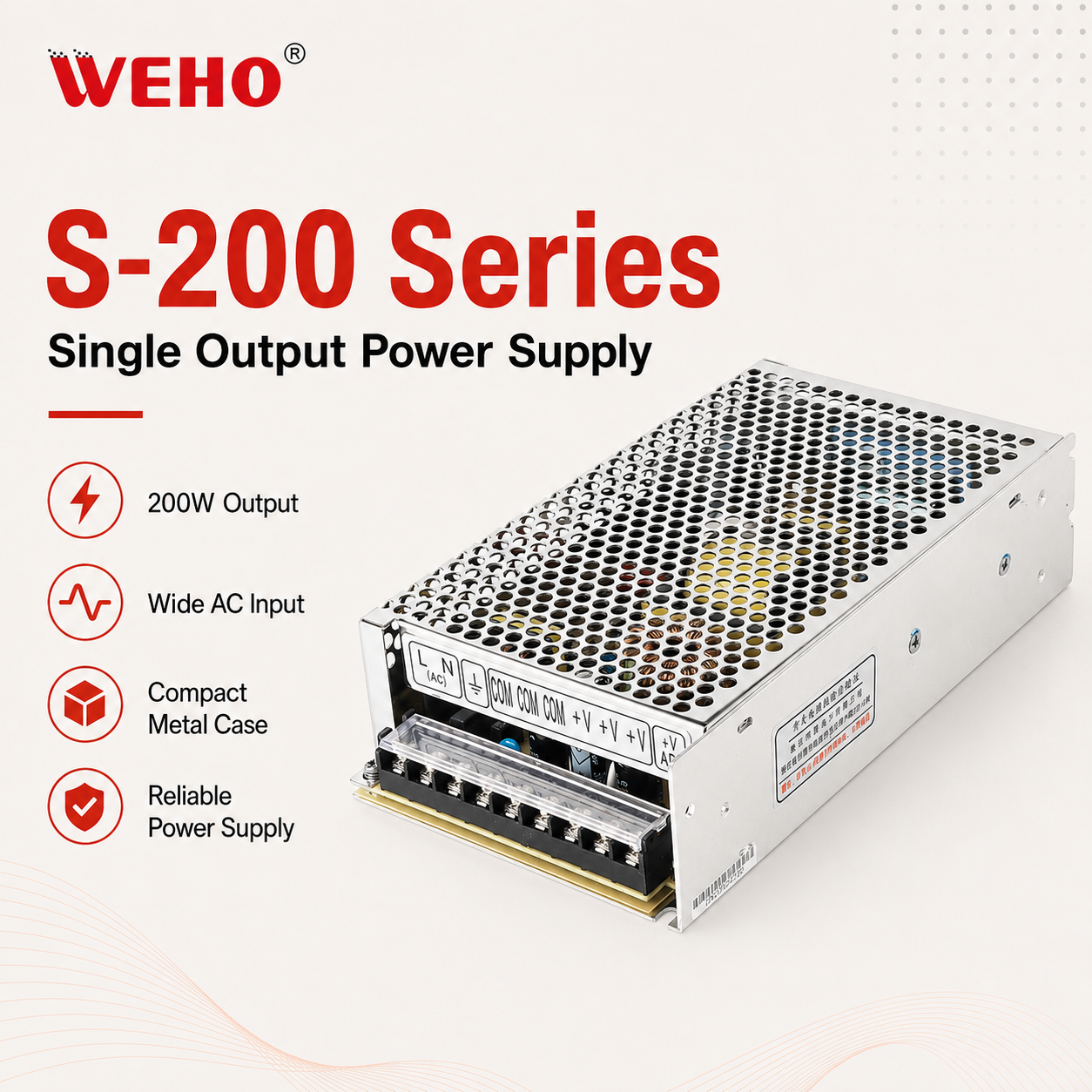
High-Capacity EDR (120W-240W)
5.5 - 7.0
87% - 91%
> 320,000 hrs
Passive Aerated Casing
Foldback, Short-Circuit, OVP
Machinery Tooling, Conveyor Belts
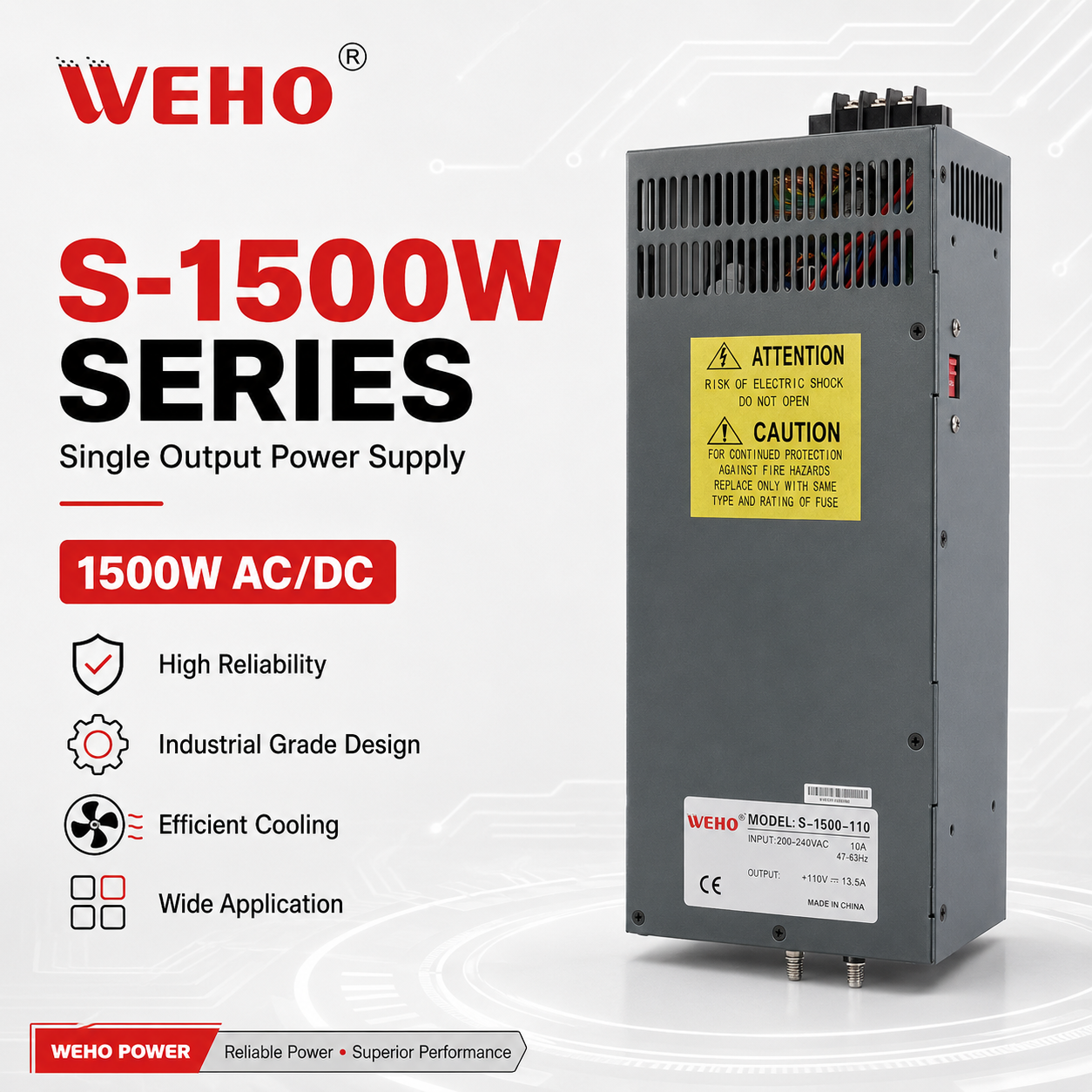
SE / SP High-Power (350W-3000W)
9.0 - 12.5
91% - 95.2%
> 280,000 hrs
Internal Thermostatically Controlled Fan
Active Shutdown & Restart, Thermal Sensor
Laser Cutters, Battery Storage, Telecom
Technological Roadmap
Industrial Power Supply Development Trends: The 2025–2030 Outlook
Analyzing fundamental technological shifts transforming industrial DIN rail power supply engineering across material science, communications telemetry, and functional safety.
1. Wide Bandgap Semiconductors (GaN & SiC)
The industrial power sector is rapidly replacing silicon MOSFETs with Gallium Nitride (GaN) and Silicon Carbide (SiC) switches. Higher electron mobility allows switching frequencies up to 500kHz+, drastically shrinking passive magnetics and transformer sizes. The result is a 40% volume reduction on standard TS-35 rails while pushing peak conversion efficiencies past 96% and minimizing cabinet cooling load.
2. Digital Telemetry: IO-Link & PMBus Integration
Isolated power supplies are transitioning into edge telemetry nodes. Modern procurement demands digital interfaces—such as IO-Link, PMBus, or Modbus RTU—reporting real-time output current, internal hot-spot temperatures, remaining electrolytic capacitor health, and mains voltage sags directly to upstream PLCs for predictive maintenance (PdM) before catastrophic line stops occur.
3. Active Redundancy (OR-ing MOSFETs)
Traditional Schottky OR-ing diodes in N+1 redundant parallel power configurations dissipate massive heat due to forward voltage drops. Modern architectures incorporate smart active OR-ing controllers with ultra-low Rds(on) power MOSFETs. This eliminates dedicated external heat-sinking modules and delivers ultra-fast microsecond decoupling during sudden internal short circuits.
Strategic Sourcing Insights
Future Sourcing & Procurement Trends for Industrial B2B Buyers
Navigating geopolitical volatility, component shortages, and strict decarbonization mandates requires procurement teams to recalibrate their supply chain frameworks.
Dual-Source Modular Platforms
Global tier-1 OEMs are moving away from proprietary mechanical footprints. Procurement teams prioritize pin-compatible, drop-in replacement designs (matching standard LRS, MDR, and NDR case dimensions) that decouple assembly lines from single-supplier lead time bottlenecks.
TCO vs. Initial Unit Price
Procurement officers increasingly evaluate Total Cost of Ownership (TCO). A 2% efficiency improvement in a continuous 24/7 500W automated line saves more than the total purchase price of the power unit over a 5-year operating window via electricity savings and reduced AC cooling overhead.
Audited Traceability (SGS / ISO)
Given tighter liability frameworks across North America and the EU (CE-LVD / UL 61010-2-201), sourcing directors demand on-site third-party verifiable audits (e.g., SGS on-site factory verification) to prevent grey-market component counterfeits and invalid documentation.
Long Lifecycle Commitments
Industrial machinery typically maintains a field service life of 10 to 15 years. Buyers enforce minimum 7-to-10-year component availability agreements, mitigating premature end-of-life (EOL) engineering redesigns and expensive recertification procedures.
Factory Advantage & Process Control
Behind the Factory Floor: Zhejiang Harlon Electronic Quality Assurance
Established in 2007 in Wenzhou, Zhejiang, China, our 10,000m² manufacturing plant bridges high-capacity automated production with exhaustive aerospace-grade test protocols.
1
IQC Incoming Testing
100% parameter screening on input electrolytic caps, MOSFETs, and ferrite cores.
2
Automated SMT & AOI
High-speed precision placement with automated optical inspection for zero solder bridging.
Over 18 years dedicated to custom engineering power supplies. We provide bespoke transformer turns-ratio tuning, custom housing form-factors, conformal coating (MIL-I-46058C) against salt mist and humidity, and custom private buyer labels.
In-House EMC & Climatic Chamber
Equipped with lightning surge generators, high/low temperature humidity test chambers, earth ground loop testers, and digital spectrum analyzers for conducted emissions (EN 55032 Class B) validation directly in our plant.
SGS On-Site Assessment Verified
Full on-site operational transparency assessed and validated by SGS Group. Certified to ISO 9001 quality management guidelines, ensuring repeatable manufacturing from initial golden sample to high-volume multi-container logistics.
Knowledge Base & FAQ
Industrial Power Supply Procurement FAQ
Common technical and commercial questions answered by our chief power applications engineers.
How should engineers calculate derating when installing DIN rail units side-by-side?
Natural convection relies on chimney-effect airflow. We recommend maintaining at least 15mm horizontal spacing between adjacent DIN devices, and 40mm above and below. For ambient environments operating between 50°C and 70°C, apply a linear derating factor of approximately 2.5% load capacity per degree Celsius unless forced air cooling is introduced.
What is the difference between Constant Current Limiting and Hiccup Mode during overloads?
Hiccup mode periodically cuts output and attempts restarts, which is safe for simple cabling faults but problematic when driving high-capacitance loads or heavy inductive motors. Constant Current limiting clamps maximum current while allowing output voltage to drop proportionally, ensuring high-surge industrial loads turn on reliably without causing cyclical brownouts.
Can Harlon OEM power supplies operate from a DC bus (DC-DC Converter mode)?
Yes. Most of our standard AC/DC architectures feature universal bridge rectifiers capable of handling high-voltage DC input (typically 120VDC to 370VDC) connected directly to the L/N terminals regardless of polarity. We also engineer specialized low-voltage DC-DC converters for vehicle, rail, and battery backup systems.
What custom parameters are supported under your OEM/ODM program?
Our engineering division tailors non-standard output voltages (e.g., 3.3V, 15V, 28V, 36V, 60V, or up to 110VDC), conformal PCB coatings, heavy-duty marine corrosion packages, customized metal stamping enclosures, wide operating temperatures (-40°C to +85°C), multi-rail isolated outputs, and private label silkscreening.
What trade terms, lead times, and payment currencies are accommodated?
We support standard international commercial terms including FOB Ningbo/Shanghai, CIF, CFR, EXW, and DDU. Sample prototypes ship within 3–7 days; batch production orders typically fulfill in 15–25 working days. Payment can be settled via T/T, L/C at sight, PayPal, or Western Union in USD, EUR, HKD, or CNY.
How do you guarantee quality traceability across high-volume production?
Each power supply unit receives a serialized QR/barcode upon entering SMT production. This serial links raw component lot numbers, automated optical inspection records, burn-in chamber thermal logs, and final automated hi-pot leakage measurements, ensuring full traceability throughout the 3-year warranty period.
Connect Directly with Harlon Power Supply Engineers
Accelerate your project qualification. Whether you need standard catalog models in container volumes, specialized DIN rail clips, or an entirely custom switch-mode PCB topology, our application engineers respond within 24 hours.
Rapid turn-around on engineering drawings and evaluation samples
Complete verification test reports (Thermal, Hi-Pot, Surge, EMI)
Direct factory pricing with comprehensive OEM/ODM brand labeling
 Deutsch
 Español
 Français
 Português
 Italiano
 Русский
 العربية
 Türkçe