Precision-engineered switching power supplies designed for DIN rail automation cabinets, low-profile LED displays, telecommunication transceivers, and rugged industrial controllers. 100% full-load burn-in verified.
Modern electronic equipment demands unprecedented power density ($W/in^3$). Minimizing the physical footprint of an AC/DC switching power supply requires resolving the delicate equilibrium between switching frequency, magnetic core saturation, thermal dissipation, and electromagnetic interference (EMI).
Conventional hard-switching flyback topologies incur heavy capacitive turn-on losses ($P_{sw} = \frac{1}{2} C V^2 f$). For high-efficiency mini switching power supplies below 150W, modern Chinese manufacturers deploy Quasi-Resonant (QR) valley-switching and Active Clamp Flyback (ACF). For medium power ranges (200W–600W), LLC resonant half-bridge converters maintain Zero Voltage Switching (ZVS) across varying loads, slashing heatsink mass by up to 45%.
Gallium Nitride (GaN) and Silicon Carbide (SiC) switches possess superior electron mobility and zero reverse-recovery charge ($Q_{rr}$). Integrating primary GaN High Electron Mobility Transistors (HEMTs) enables switching frequencies beyond 200kHz without catastrophic thermal runaway. This drastic frequency boost allows the transformer winding volume and primary filtering bulk capacitance to shrink into ultra-compact, low-profile chassis formats.
Compacting an SMPS increases parasitic inductive coupling between high-$di/dt$ switching loops and metal enclosures. Top-tier manufacturers in Zhejiang apply multilayer PCB shielding, symmetrical common-mode choke designs, and spread-spectrum frequency jittering. This guarantees stringent compliance with EN 55032 / CISPR 32 Class B limits without ballooning the external filter package size.
Procurement leaders must calibrate their supply chain strategies according to macro shifts in energy efficiency mandates, modular system integration, and global environmental standards.
Regulatory bodies worldwide—including EU ErP Lot 6/Lot 7 and US DoE Level VI standards—are enforcing strict limits on no-load standby consumption (< 0.15W to 0.075W) and active four-point average efficiency. In mini enclosures, every single watt of heat dissipated is critical; an efficiency jump from 88% to 94% slashes internal thermal rejection by 50%. Future-proof RFQs will universally require synchronous rectification (SR) and active power factor correction (PFC) across models over 75W.
Industrial edge-computing nodes, decentralized PLC panels, and shallow depth IoT display enclosures have made standard cubic metal-cage power supplies obsolete. Global procurement is shifting heavily toward ultra-slim, 30mm 1U profile enclosed units (exemplified by the LRS family) and step-shape DIN rail power supplies (MDR, NDR, EDR series). These architectures optimize convective airflow along vertical rail channels without requiring noisy, high-failure-rate active fans.
Enterprise buyers are moving away from bidding wars that sacrifice internal bill-of-materials (BOM) reliability. The actual cost of an industrial power supply failure includes expensive field technician dispatches and production line downtime. Technical audits now scrutinize primary electrolytic capacitor operating ratings (105°C long-life brands such as Rubycon or Nichicon equivalents), MTBF calculations via Telcordia SR-332 or MIL-HDBK-217F, and guaranteed derating curves at 60°C ambient temperatures.
While basic analog SMPS units still anchor cost-sensitive lighting lines, industrial automation and telecom clusters increasingly request mini supplies with embedded microcontrollers (MCUs). The integration of PMBus or Modbus RTU telemetry enables host controllers to monitor voltage sag, load currents, internal junction temperatures, and total runtime hours. This enables predictive maintenance schedules prior to physical capacitor dry-out or component wear.
Compare mechanical topologies, electrical parameters, cooling dynamics, and optimal deployment scenarios across core industrial product series.
| Series Archetype | Wattage Spectrum | Input Range (AC) | Efficiency | Cooling Mode | Target Applications | Key Standard |
|---|---|---|---|---|---|---|
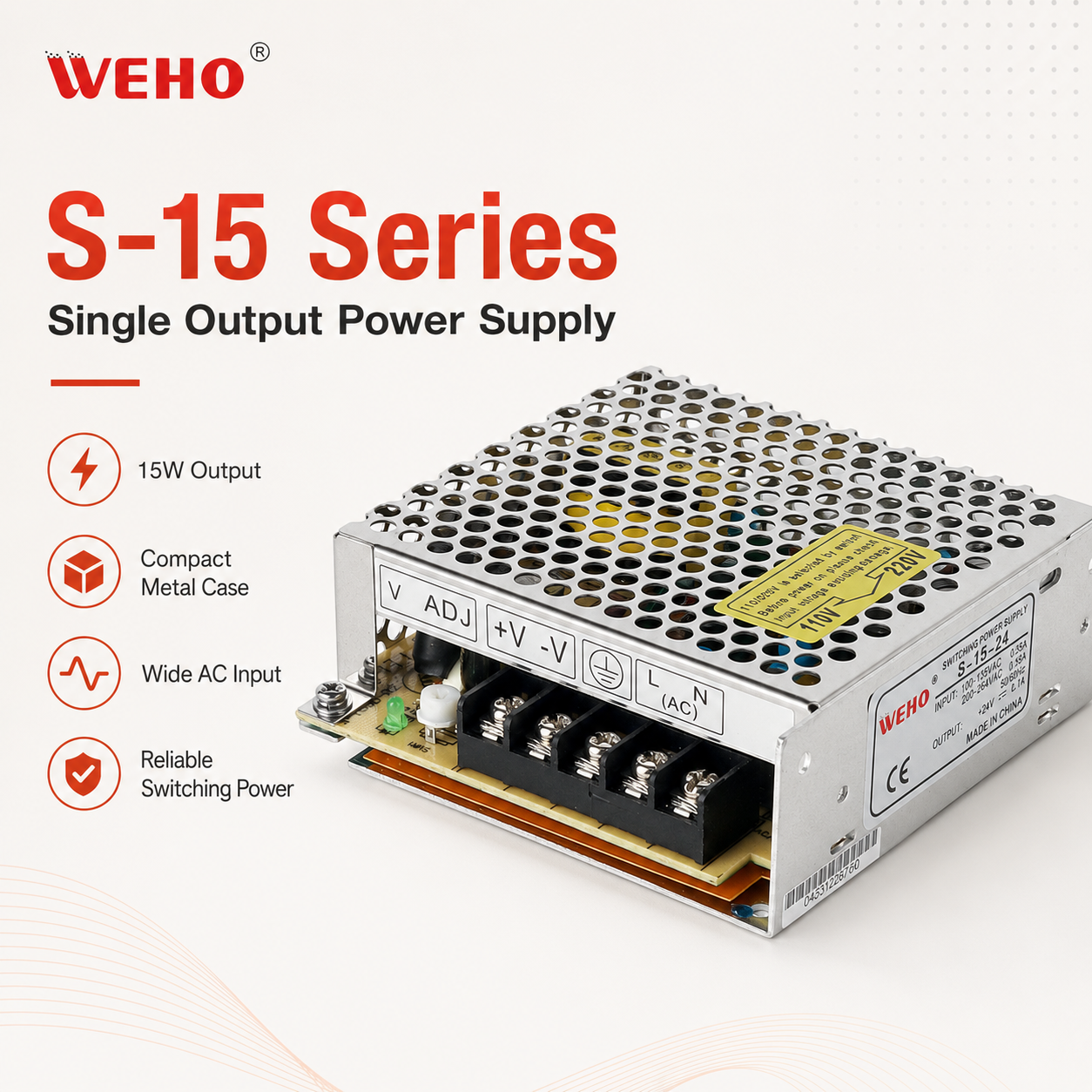
| Micro Enclosed (S-15 to S-50) | 15W – 50W | 85 – 264 VAC Universal | 82% – 88% | Free-air Convection | Access control, sensors, small displays | EN 62368-1 |
| Ultra-Slim 1U (LRS Equivalent) | 35W – 350W | 85 – 264 VAC / Selectable | 87% – 91.5% | Convection (Fan > 200W) | 3D printers, LED signage, CNC rails | UL 62368-1 / CE |
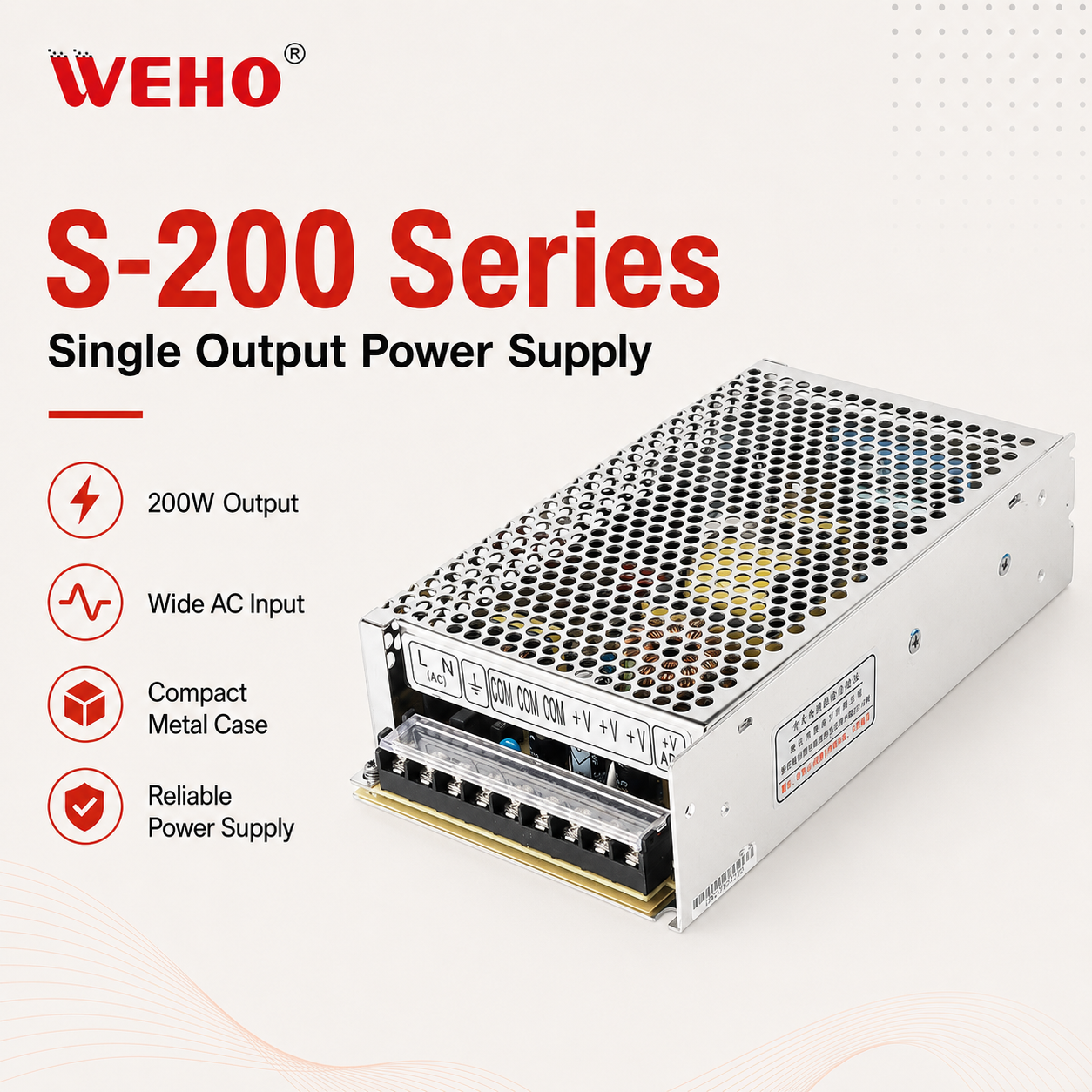
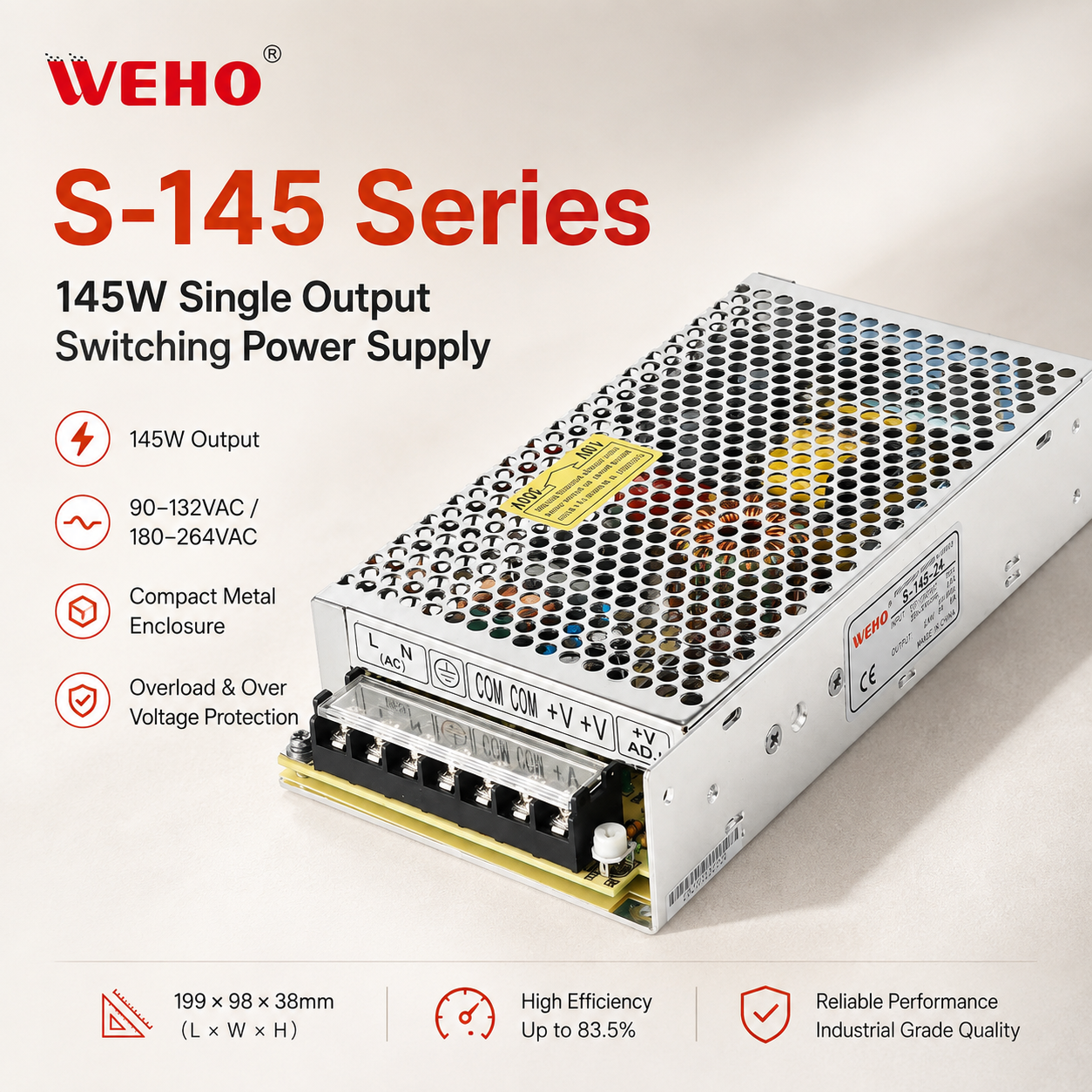
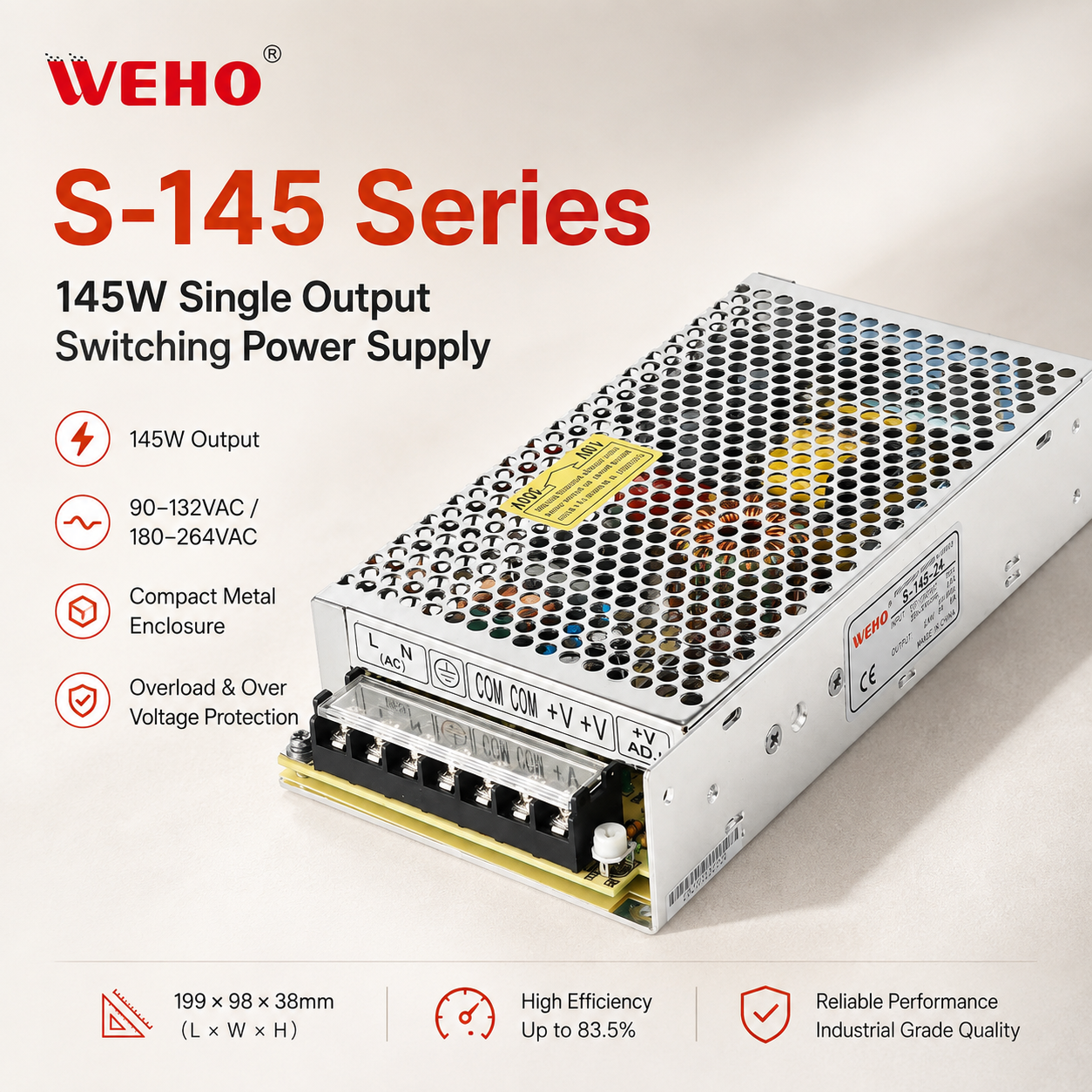
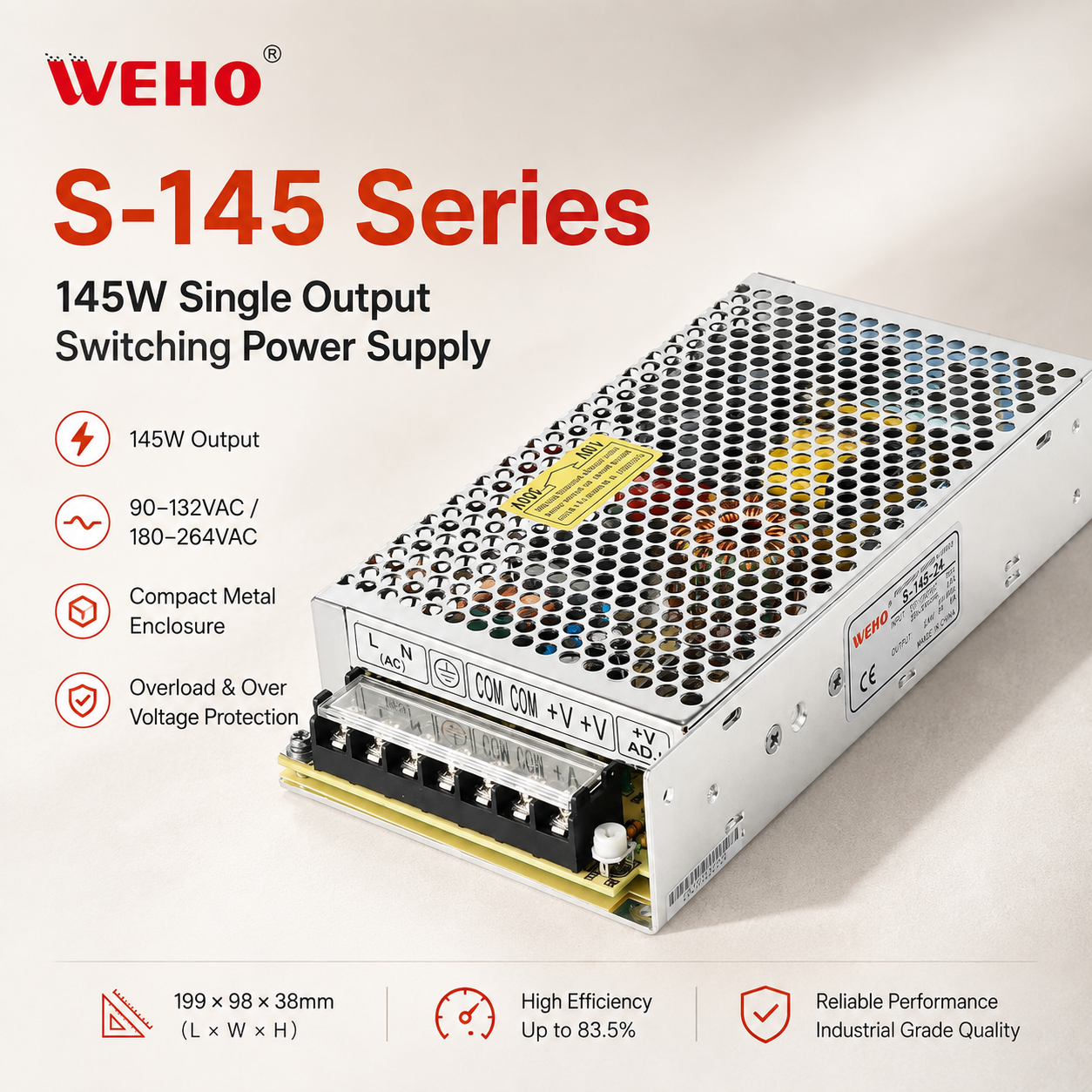
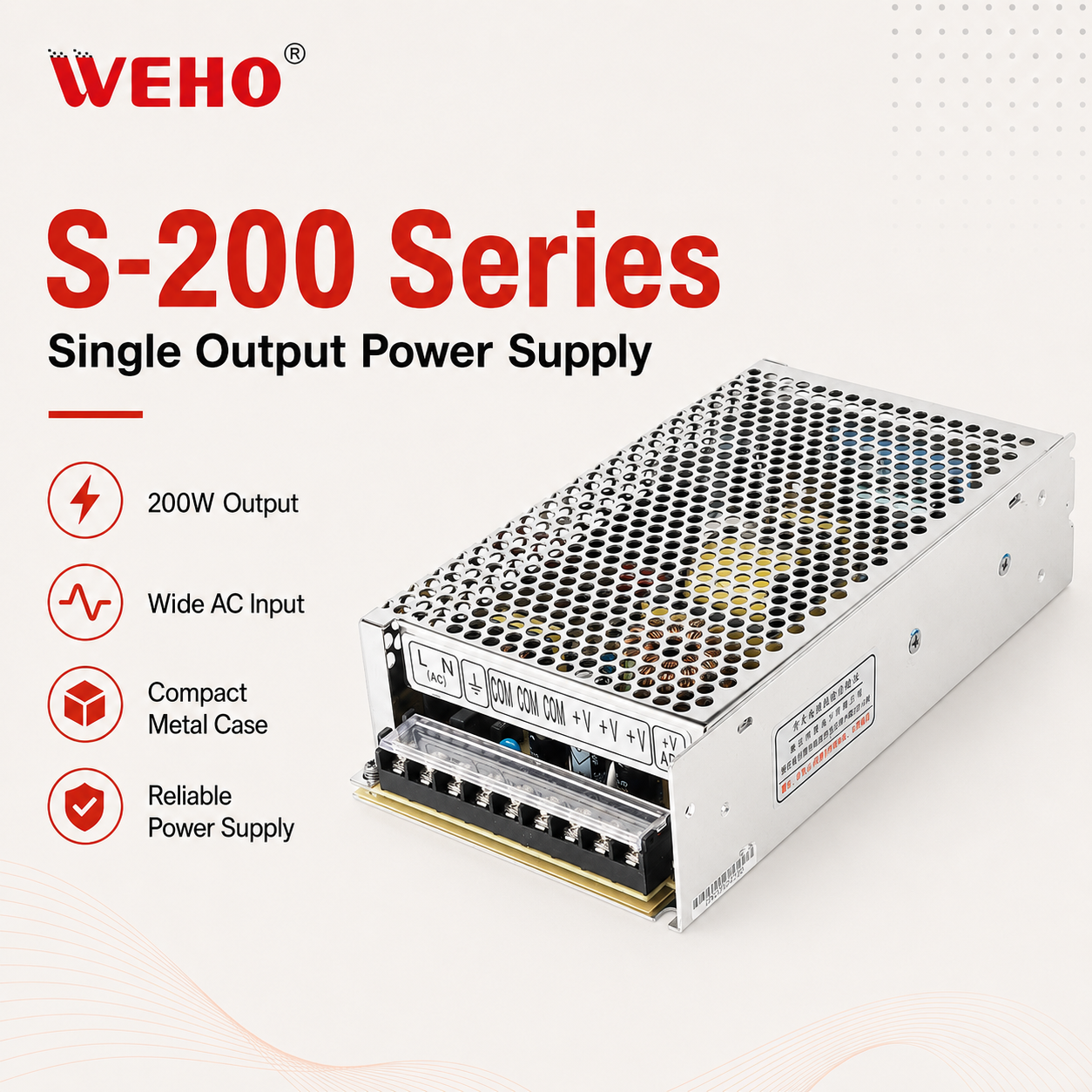
| Mid-Power Enclosed (S-145 to S-200) | 145W – 200W | 110V / 220V Dual Switch | 85% – 89% | Convection / Perforated Case | CCTV clusters, industrial stepper motors | CE / RoHS / FCC |
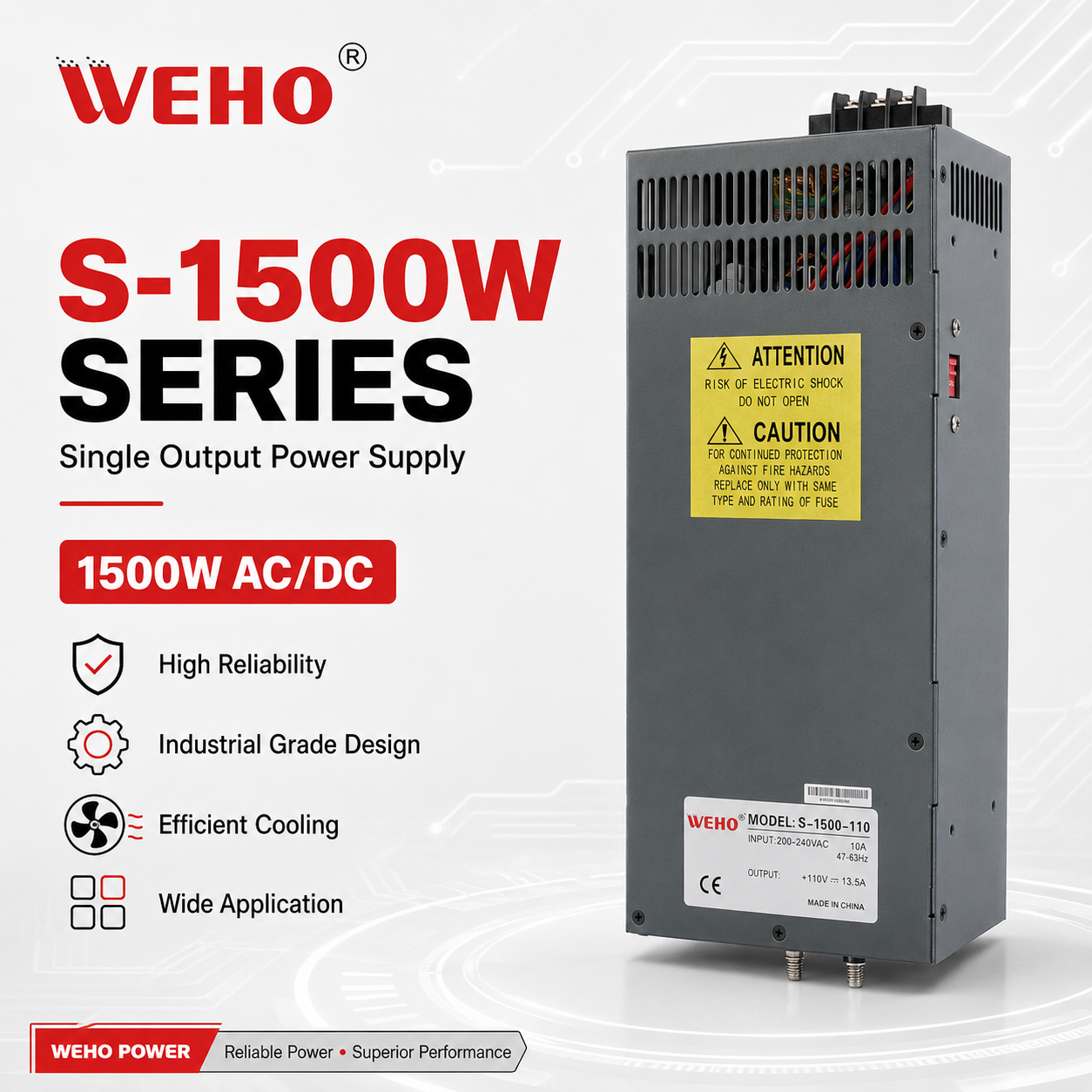
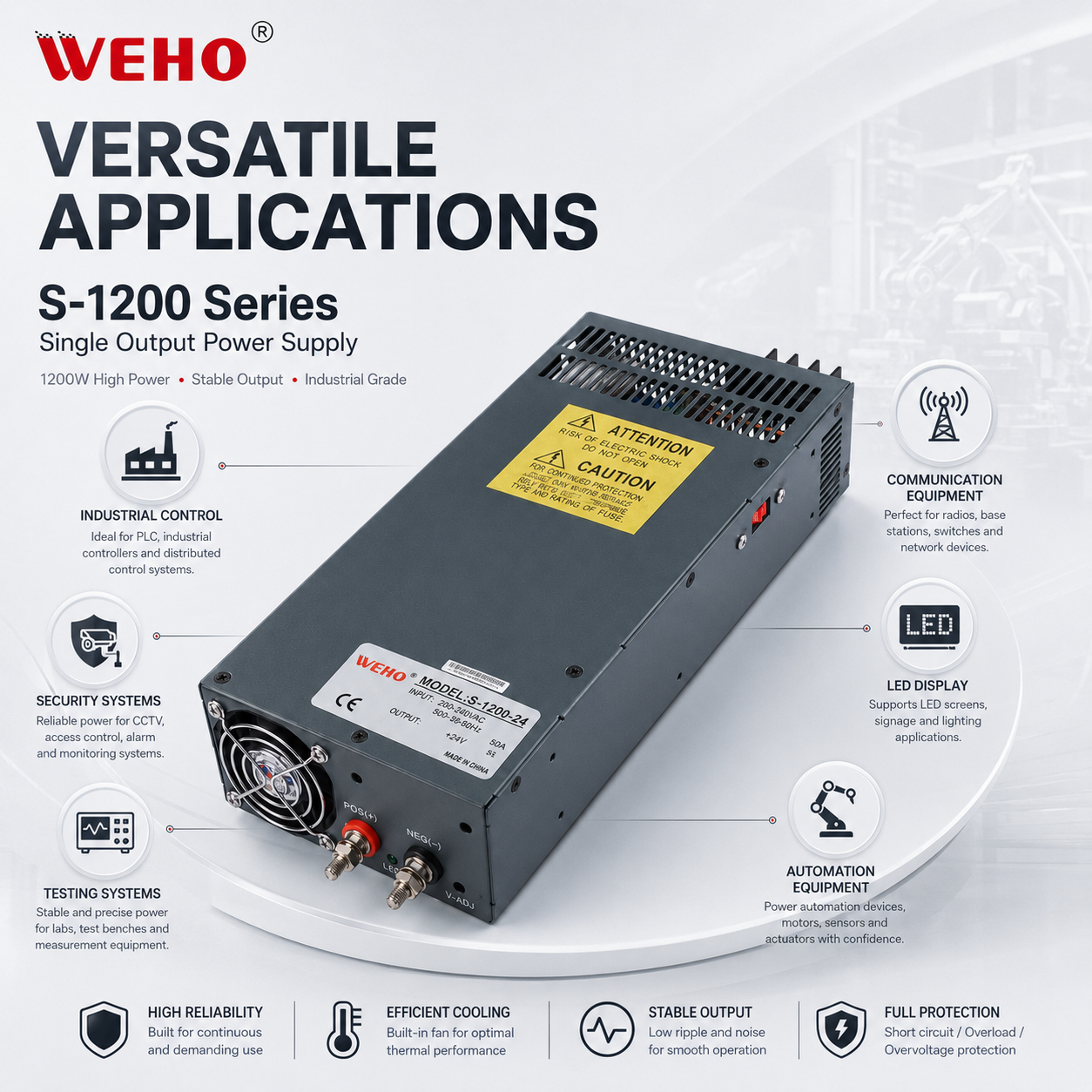
| High-Power Compact (S-1200 / S-1500) | 1200W – 1500W | 180 – 264 VAC / 220 VAC | 90% – 93% | Intelligent Forced Air Fan | Laser cutters, battery chargers, telecom | Active PFC / CE |
| Industrial DIN Rail (MDR / NDR) | 20W – 480W | 90 – 264 VAC Full Range | 88% – 94% | Natural Convection (TS-35 Rail) | Distribution boards, PLC cabinets, SCADA | EN 61000-6-2 (Immunity) |
*Note: All units feature standard short circuit, over-voltage, over-current, and internal thermal cutoff protections with auto-recovery or hiccup mode.
Zhejiang Harlon Electronic Co., Ltd. integrates 19 years of continuous power supply engineering with end-to-end production automation in Wenzhou, China. Audited and verified on-site by SGS Group.
Complete physical transparency. Our factory campus spans over 10,000 square meters, housing more than 10 dedicated assembly, SMT, insertion, and packaging lines with 51–100 seasoned production specialists.
Equipped with high-precision Yamaha and Panasonic pick-and-place surface mount machines, automatic stencil printers, and 8-zone reflow ovens to guarantee zero component misalignment and ideal solder joint fillets.
Bulk inductors, primary transformers, and power capacitors undergo high-speed automated axial/radial insertion followed by computer-controlled nitrogen-inert wave soldering, eliminating cold solder defects.
Every manufactured unit is subjected to an accelerated life test inside our 45°C–50°C thermal aging chambers under 100% full dynamic load. This process eliminates early component mortality before packaging.
Equipped with internal lightning surge generators, EMI conduction test receivers, hi-pot dielectric insulation testers, and high/low temperature environmental chambers to ensure international certifiable designs.
Supported by 30+ years of power supply design expertise from our engineering leaders. We offer custom chassis metalwork, multi-rail split outputs, custom cabling, private labeling, and tailored packaging.
Key commercial, technical, and regulatory considerations to streamline vendor qualification and technical review.
Unlike intermediary trading operations, Zhejiang Harlon Electronic Co., Ltd. is an original equipment manufacturer operating an ISO 9001 certified plant in Wenzhou, verified on-site by SGS. We control every phase: raw material IQC with dedicated component testing, automatic SMT, wave soldering, optical inspection, full-load burn-in testing, and automated parameter testing with data logging.
Due to compact heat dissipation boundaries, mini power supplies without active cooling fans typically operate at 100% rated capacity up to an ambient temperature of 40°C–50°C. Above this point, standard thermal derating requires a linear decrease of 2% to 2.5% load per °C increase up to 70°C. For enclosed panels with high thermal loads, we recommend factoring a 20%–25% power reserve margin.
Yes. We offer complete sample-based and design-based OEM/ODM customization. Standard voltage trims include 3.3V, 5V, 12V, 15V, 24V, 36V, 48V, and custom secondary rail taps. We also support specialized mounting brackets, IP67 waterproof potting, custom wire harnesses, laser-etched nameplates, buyer branding, and customized multi-language retail/master cartons.
We support flexible global shipping arrangements, including FOB Ningbo/Shanghai, CIF, CFR, EXW, and DDU/DDP via air or express courier. Commercial payment terms include T/T, L/C at sight, PayPal, and Western Union in multiple currencies (USD, EUR, HKD, CNY), backed by international trade credit documentation.
High-frequency ripple and switching spikes are minimized through secondary-stage low-ESR solid electrolytic capacitors paired with discrete LC post-filters. Ferrite beads are strategically placed across rectifier diodes, and optimized PCB layout practices ensure physical separation between high-voltage switching loops and feedback sensing traces, keeping output ripple within 50mV to 120mV peak-to-peak.
Standard catalog samples are dispatched within 2–5 business days. Customized prototypes involving modified transformer turns or custom metal chassis work take approximately 10–15 business days. Mass production lead times range between 20 to 30 days depending on component allocations and total batch volume.
Ensure reliable system integration by verifying these electrical, thermal, and manufacturing checkpoints before placing bulk production orders.
• Universal wide AC input tolerance (85V–264V) or manual 115V/230V selector switch reliability.
• Inrush current limiting rating (NTC thermistor or active bypass relay).
• Surge withstand capability: Line-to-Line ±1kV/2kV, Line-to-Earth ±2kV/4kV per IEC 61000-4-5.
• Hold-up time: Minimum ≥16ms to 20ms at full nominal load.
• Component thermal margins: Verify electrolytic capacitors operate below 85°C at peak ambient.
• Chassis plating: Zinc-plated or anodized aluminum case resistant to salt-spray and oxidation.
• Shock and vibration endurance testing matching IEC 60068-2-6 standard requirements.
• Terminal block screw torque ratings and flame-retardant grade (UL 94V-0).
• Verify genuine certificate registration numbers for CE, RoHS, FCC, and CB reports.
• Valid ISO 9001 quality management framework with documented traceability.
• Independent third-party audit reports (such as SGS or TÜV on-site assessments).
• Component BOM transparency: Documented brand sources for primary semiconductor switches.